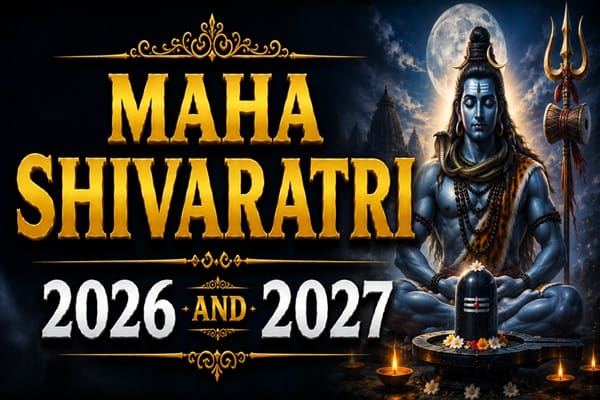
The moon is dark. The night is long. And millions of people across India and the world will stay awake, not sleeping, but waiting. Waiting for the midnight hour when the cosmos aligns and Lord Shiva is at his most receptive. This is Maha Shivaratri, the Great Night of Shiva. Unlike most Hindu festivals that burst with colors and feasting, Maha Shivaratri is a night of silence, fasting, and inner focus. The temples will be packed. The chants of Om Namah Shivaya will echo through the streets. And somewhere in the darkness, a lamp will be lit, not just outside, but inside.
The date changes every year because the Hindu lunar calendar is different from the solar calendar. In 2026, Maha Shivaratri falls on Sunday, 15 February. In 2027, it falls on Saturday, 6 March. Mark these dates. The preparation begins not on the day, but the night before.
The Stories Behind the Great Night
Ask ten devotees why they observe Maha Shivaratri, and you might get ten different answers. Each story is a thread in the same divine cloth.
One belief says this is the night Lord Shiva married Goddess Parvati. Their union is not just a marriage between two deities. It represents the balance between consciousness and energy, stillness and power, the masculine and the feminine. Every married couple who prays on this night seeks that same balance in their own relationship.
Another story takes us back to the churning of the ocean. The gods and demons churned the cosmic ocean to obtain the nectar of immortality. But before the nectar appeared, a deadly poison emerged. It was so toxic that it could destroy all creation. The gods turned to Shiva. Without hesitation, he drank the poison. His wife Parvati pressed her hand on his throat to stop the poison from going down. The poison stayed there, turning his neck blue. That is why he is called Neelkanth, the blue throated one. Maha Shivaratri is the night devotees thank him for that act of selfless sacrifice.
A third story connects the festival to Shiva’s cosmic dance, the Tandava. This dance represents the cycle of creation, preservation, and destruction. Everything that begins must end. Everything that ends makes space for something new. On Maha Shivaratri, devotees meditate on this truth. They let go of attachments. They prepare for transformation.
The Exact Dates and Auspicious Timings for 2026 and 2027
In 2026, Maha Shivaratri is on Sunday, 15 February. The Chaturdashi Tithi, the 14th day of the dark fortnight, begins on the morning of 15 February and ends the next morning. The most auspicious time for worship is Nishita Kaal, the midnight period. This is when the divine energies are considered most accessible.
In 2027, the festival falls on Saturday, 6 March. The Nishita Kaal puja runs from approximately 12:07 AM to 12:57 AM on 7 March. The entire night is divided into four prahars, each lasting about three hours. Devotees traditionally perform puja in all four prahars, but even participating in one is considered highly meritorious.
For those in the United States and other countries outside India, the date remains the same by the Hindu calendar. Check your local panchang or temple website for the exact timings in your time zone.
Fasting Rules That Are Flexible by Design
Fasting on Maha Shivaratri is not about punishment. It is about purification. You reduce the energy spent on digestion so that more energy is available for prayer and meditation. But the rules are not rigid. They adapt to your health, age, and capacity.
The strictest fast is Nirjala, no food and no water. This is for the young and healthy. Do not attempt it if you have medical conditions, are pregnant, or are elderly.
The Phalahar fast allows fruits, milk, and water. This is the most common type. You can eat bananas, apples, dates, and any seasonal fruit. Milk, curd, paneer, and nuts are also allowed.
The Milk fast is exactly what it sounds like. Only milk and water. This is simpler than the fruit fast but still requires discipline.
The Single Meal fast involves eating one light satvik meal after the evening puja. This is ideal for beginners or those who cannot handle longer fasting.
What you avoid matters as much as what you eat. No rice, wheat, or grains. No onion or garlic. No non vegetarian food. No alcohol or tobacco. No spicy or oily food. These items are considered tamasic, meaning they increase restlessness and dull the mind. On a night meant for clarity, you want only satvik food.
Children below a certain age, pregnant women, the elderly, and those with medical conditions should not fast strictly. They can offer prayers and participate in the rituals without food restrictions. Devotion is not measured by how much you suffer, but by how sincerely you offer.
Puja Vidhi You Can Do at Home
You do not need a temple or a priest to observe Maha Shivaratri. A simple puja at home, done with focus and love, is just as powerful.
Wake up early. Take a bath. Wear clean, preferably white or saffron clothes. White represents purity. Saffron represents renunciation. Both are appropriate.
Clean the space where you will perform the puja. Place a Shiva Lingam or a picture of Lord Shiva on a clean platform. If you do not have a Lingam, a simple image works.
The main ritual is Abhishekam, the bathing of the Shiva Lingam. You pour sacred substances over the Lingam while chanting Om Namah Shivaya. Each substance has a meaning.
Water represents purity and cleansing. Milk represents devotion and nourishment. Honey represents sweetness and harmony. Curd represents prosperity and balance. Ghee represents strength and energy. Sugar or fruit juice represents happiness. Vibhuti, sacred ash, represents the impermanence of the body.
If you do not have all these items, water alone is enough. Shiva accepts what is offered with love.
After the Abhishekam, offer Bel Patra, the leaves of the wood apple tree. These are considered the most sacred offering to Shiva. They must have three leaflets, representing the three eyes of Shiva. Offer flowers, preferably white or pale colors. Light a lamp and incense. Offer fruits and sweets.
Chant the mantra Om Namah Shivaya. You can chant it eleven times, one hundred and eight times, or as many times as you can. If you have a rudraksha mala, use it to count. The repetition of the mantra calms the mind and creates a vibration that aligns you with the deity.
Sit quietly for a few minutes after the chanting. Do not rush to finish. Let the energy settle. If you feel moved, read a few verses from the Shiva Purana or listen to a recording of the Maha Mrityunjaya Mantra.
The Night Vigil That Changes You
Staying awake all night is called jaagran. In a world where sleep is a priority, giving up an entire night for prayer feels like sacrifice. But the tradition is not about suffering. It is about awareness.
When you stay awake, you are saying that the divine is more important than your comfort. You are training your mind to remain alert, to not slip into unconsciousness. That alertness, carried into daily life, helps you respond to situations instead of reacting.
The night is divided into four prahars. At temples, priests perform special pujas in each prahar. Devotees gather to sing bhajans, listen to discourses, and chant together. The collective energy is powerful. If you are at home, you can structure your night. Chant for one prahar. Read scriptures for the next. Meditate for another. Listen to devotional music for the final one.
Do not sleep. That is the only rule. If you feel tired, walk around. Drink water if you are not on a Nirjala fast. Keep your mind engaged. The hours will pass faster than you expect.
Also Read : Muramalla Temple Darshan Timings 2026: Nitya Kalyanam Booking, Sevas, Festivals
Mantras That Carry Power
Sound is not just vibration. In the Hindu tradition, sound is creation itself. The syllables of Sanskrit mantras are not random. They are coded formulas that affect the mind and the body.
The simplest and most powerful mantra is Om Namah Shivaya. It means I bow to Shiva. The five syllables, Na Ma Shi Va Ya, represent the five elements, earth, water, fire, air, and ether. Chanting this mantra balances the elements within you.
The Maha Mrityunjaya Mantra is chanted for protection and healing. Om Tryambakam Yajamahe, Sugandhim Pushtivardhanam, Urvarukamiva Bandhanan, Mrityor Mukshiya Maamritat. We worship the three eyed one, who is fragrant and nourishing. May he release us from the bondage of death, just as a cucumber is released from its vine. This mantra is especially powerful when chanted for someone who is ill.
The Rudra Gayatri is another powerful prayer. You do not need to be a Sanskrit scholar to chant these. Even imperfect pronunciation, when done with faith, carries meaning.
Use a rudraksha mala to keep count. The beads are said to have been formed from the tears of Shiva. Touching them while chanting creates a direct connection.
Celebrations Across Cities and Villages
In Varanasi, the city of Shiva, the ghats fill with devotees as early as 3:00 AM. They bathe in the Ganges, then walk to the Kashi Vishwanath Temple. The lines stretch for kilometers, but no one complains. The patience is part of the offering.
In Ujjain, home to the Mahakaleshwar Temple, the Bhasma Aarti is the highlight. The priests apply ash from the funeral pyre to the deity, a stark reminder of death and impermanence. Thousands gather in the dark to witness it.
In South India, the focus is on Abhishekam. Milk, curd, honey, and sandalwood paste flow over the Shiva Lingam in a continuous stream. The priests chant the Vedas. The devotees sit in silence, absorbing the vibrations.
In West Bengal and Odisha, the observances are quieter. Devotees fast strictly and visit Jyotirlinga temples. Many travel to Somnath, Kedarnath, and Mallikarjuna.
In the United States, Hindu temples in New York, California, Texas, and New Jersey hold night long programs. For those who cannot attend, live streams allow participation from home. The diaspora keeps the tradition alive, passing it to children who have never seen India.
What the Festival Means for You
You do not have to be a devotee of Shiva to benefit from Maha Shivaratri. You do not have to be Hindu at all. Take one night. Stay awake. Sit in silence. Watch your thoughts without acting on them. Notice how many of them are fears, how many are regrets, how many are just noise.
Let them pass. Do not hold on to any. By morning, you will feel lighter. The problems that seemed insurmountable will look different. Not because they have changed, but because you have.
Shiva is the destroyer. Not of the world, but of the illusions that bind you. The illusion that you are separate from the divine. The illusion that happiness comes from outside. The illusion that time is running out. On Maha Shivaratri, you sit with these illusions. And you let Shiva destroy them.
The fast, the puja, the mantras, the night vigil, these are tools. They are not the goal. The goal is transformation. A shift in consciousness. A moment of awakening.
On 15 February 2026 and 6 March 2027, millions will light lamps, chant mantras, and stay awake. Join them. Not because you have to, but because something in you knows that the night is holy. And that the darkness, when faced with awareness, reveals the light.