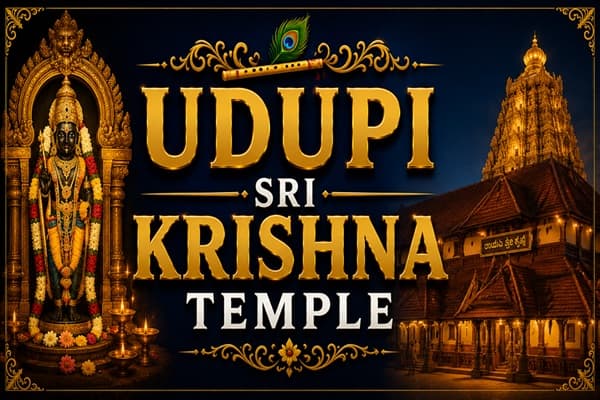
The morning air fills with the sound of bells. Priests move quickly through the corridors. A queue forms outside the main entrance, people waiting patiently for their first glimpse of Lord Krishna. But here, you do not see the idol directly. You look through a small window with nine holes. That window changes everything. That window is the soul of the Udupi Sri Krishna Temple.
Located in the coastal town of Udupi in Karnataka, this temple is not just another pilgrimage stop. It is one of the seven Mukti Sthalas, places believed to grant spiritual liberation. Devotees call Udupi the second Mathura. The temple sees thousands of visitors every single day. Families come from Bangalore. Solo travellers come from Mumbai. International tourists find their way here too. Everyone leaves with a story.
This guide covers everything you need. Temple timings, the famous window, the history behind the idol, the eight Mathas, festivals, how to reach, and nearby places. No fluff. Just practical, clear information that helps you plan a smooth visit.
The Story Behind The Temple
The Udupi Sri Krishna Temple traces its roots to the 13th century. The great philosopher and saint Madhwacharya founded this temple. He also established the Dvaita school of Vedanta, one of the main branches of Hindu philosophy. His influence on the temple remains strong even today, nearly 800 years later.
The story of how the idol came to be here is fascinating. Legend says Madhwacharya found the idol of Lord Krishna inside a large ball of gopichandana, a type of sandalwood paste. The idol showed Lord Krishna as a small boy holding a churning rod in his right hand and a rope in his left hand. This unique representation cannot be seen anywhere else in India.
Madhwacharya handed over the temple management to eight of his disciples. These eight disciples established their own Mathas, or monastic institutions. They took turns managing the temple. That system continues to this day.
The Unique Window That Defines The Temple
Most temples have an open sanctum where you can see the idol directly. Not this one. The main door of the sanctum stays closed. Devotees see Lord Krishna through a grilled window called the Navagraha Kitiki. This window has nine squares, each dedicated to one of the nine planets.
The window also carries the name Kanakana Kindi, which means Kanaka’s window. This name comes from a beautiful story about the saint Kanakadasa. He belonged to a low caste and was not allowed entry into the temple. But his devotion did not waver. He went behind the temple and prayed through a small crack in the wall. Pleased with his dedication, the idol of Lord Krishna turned around to give him darshan. The small window in the wall became a permanent opening. The Kanakadasa Mantapa next to it holds a statue of the saint, a must see spot for every visitor.
The window faces the west. The idol also faces the west. This westward orientation is unusual because most temple idols face east. Madhwacharya designed it this way intentionally, representing a specific philosophical principle.
Temple Timings You Need To Know
The temple opens at 4:30 AM every single day. It closes at 9:30 PM. Unlike many temples, there is no separate special darshan here. Everyone stands in the same queue. Everyone gets the same view. The temple authorities do not sell VIP tickets or special entry passes. This equality was Madhwacharya’s vision.
Morning hours from 5 AM to 11 AM see the highest crowd. Evening hours from 5 PM to 9 PM are relatively quieter. The temple remains open through the afternoon. There is no midday closing here. You can visit at any time within the operating hours.
Several specific rituals happen throughout the day. Nirmalya Visarjana Puja happens at 4:50 AM, where priests remove the previous day’s decorations and bathe the idol. Ushakala Puja follows at 6 AM with Abhishekam using holy water. Vishwaroopa Darshana at 6:20 AM offers devotees a special view of the decorated deity. Panchamritabhisheka at 6:30 AM involves bathing the idol with milk, curd, honey, ghee, and sugar.
The most important ritual is the Mahapuja at 11 AM. The head of the Matha personally performs this ceremony. He offers rice, Tulasi, and sandal paste while priests chant the Vishnu Sahasranama and other sacred texts. After the Mahapuja, the doors close for a short while. Devotees believe that Madhwacharya himself makes the offerings during this time.
Evening rituals start at 7 PM with Chamara Seva. Ratripuja happens at 7:30 PM. The final ritual is Ekantha Seva at 8:50 PM, where the Utsava murti, the processional idol, is placed in a golden cradle. Priests sing lullabies and blow a conch to signal the end of the day.
The Eight Mathas And The Paryaya System
Eight Mathas surround the main temple complex. Each Matha was founded by one of Madhwacharya’s direct disciples. Their names are Palimar Mutt, Krishna Mutt, Kaniyour Mutt, Sode Mutt, Puttige Mutt, Admar Mutt, Shirur Mutt, and Pejawar Mutt.
These Mathas take turns managing the temple. The rotation happens every two years. This system is called Paryaya. When a Matha’s turn comes, its head becomes the administrator of the temple for two years. The Paryaya festival marks this handover. Thousands gather to witness the ceremony. The next festival happens once every two years, so check the schedule before planning your visit.
Each Matha has its own speciality. Pejavara Matha is known for its scholarly interests. Puttige Matha focuses on religious rites. Sodhe Matha contributes to Sanskrit literature. Kaniyur Matha emphasizes meditation. Palimar Matha applies Dvaita philosophy to daily life. Admaru Matha is known for theological studies. Each brings its own flavour to the temple management.
Festivals That Bring The Temple Alive
Krishna Janmashtami is the biggest festival here, celebrated in August or September. Devotees fast for the entire day. The next day morning, a clay image of Sri Krishna is taken around the town in a chariot. The Handi ceremony involves breaking clay pots hung between buildings. People dress as animals and masked figures, parading through the streets. The idol is finally submerged in the Madhava Sarovar, the temple tank.
The Saptotsava festival lasts seven days in January, around Makara Sankranthi. For the first five days, the idols of Lord Krishna and Lord Mukhyaprana, who is Hanuman, are placed on the Garuda ratha. The idols of Lord Anantheshwara and Lord Chandreshwara ride on the Mahapuja ratha. Both chariots are pulled around the town.
On the sixth day, Makara Sankranthi day, the priests place the Utsava Murthis in a golden palanquin and take them to the Madhava Sarovar. There they transfer them to a decorated float and take them around the water. This is called Teppotsava. Devotees believe Madhwacharya installed the idol on this exact day.
On the seventh and final day, after the Mahapuja, the Utsava Murthis go to the Brahma Ratha, the main chariot. A garuda, an eagle, always circles above the chariot during this ritual. After the chariot moves around the Ratha street and reaches the Madhava Sarovar, priests bathe the Lord. Then everyone takes a dip in the Sarovar. Priests offer flowers smeared with gold paste to the Lord and then throw them into the crowd. That is the Churnotsava.
Other festivals celebrated with enthusiasm include Holi in March, Ram Navami, Narasimha Jayanti, Ganesh Chaturthi, Navaratri, Diwali, and Vasantotsava in March to April marking the start of spring.
The Idol And Its Unique Features
The main idol of Lord Krishna shows him as a small boy, a child. He holds a churning rod in his right hand and a rope in his left hand. This representation is unique to Udupi. You will not see it anywhere else in India.
The lamps kept near the idol were first lit by Madhwacharya himself in the 13th century. They have been burning continuously ever since. Temple priests maintain them with extreme care, ensuring the flame never dies.
Two other important idols sit in separate shrines within the complex. The idol of Lord Mukhyaprana, who is Hanuman, and the idol of Garuda were brought here from Ayodhya. Madhwacharya installed them himself. Devotees always visit these shrines before leaving the temple.
Dress Code And Rules
Men should not wear shirts and vests inside the temple complex. Traditional clothing like a dhoti with a kurta or a simple shirt is acceptable. Lungis are not allowed inside the sanctum sanctorum. Shorts and jeans are also not permitted.
Women should wear traditional ethnic wear like sarees or salwar kameez. Western clothing is not allowed inside. The temple authorities enforce these rules strictly. Small shops near the temple sell appropriate clothing for forgetful visitors, but the prices are higher than normal.
Mobile phones are allowed inside the temple but must be switched off. A clear notice at the entrance requests this. Many other temples ban mobiles completely, so this is a relatively relaxed rule. Still, respect the request and keep your phone off.
Remove your footwear before entering the main complex. Shoe keeping counters charge a small fee, typically five to ten rupees. Keep the token safe. Some visitors carry their shoes in a cloth bag to avoid the counters.
How To Reach Udupi Sri Krishna Temple
By air, the nearest airport is Mangalore International Airport, about 59 kilometers away. Regular flights connect Mangalore to major cities like Mumbai, Bangalore, Chennai, and Delhi. From the airport, you can hire a taxi or take a bus to Udupi. The drive takes about one and a half hours. Taxis charge approximately 1,500 to 2,000 rupees.
By train, Udupi is an important station on the Konkan Railway route. Direct trains run from Mumbai, Jaipur, Bangalore, Gokarna, Murudeshwar, Kolhapur, Trivandrum, and Madgaon. The station is about 2 kilometers from the temple. From there, auto rickshaws charge 30 to 50 rupees for the trip. Walking takes 20 to 25 minutes.
By road, state run KSRTC buses operate regularly from Bangalore, Mangalore, and Mysore. Private luxury buses also serve the route. The bus stand is about 3 kilometers from the temple. Auto rickshaws and shared cabs are easily available. The temple is walking distance from the Udupi city centre, so staying nearby makes everything convenient.
The distance from Bangalore to Udupi is approximately 400 kilometers. The Udayagiri Express from Yeshwantpur is a good train option. Several private and state run buses also operate overnight, saving you a night’s hotel stay.
Where To Stay
Udupi offers a range of accommodation options. Dharamshalas run by the temple provide very cheap rooms starting at 200 rupees per night. These are basic but clean. Ashrams also offer simple accommodation with shared bathrooms.
Budget hotels charge 800 to 1,500 rupees per night. Hotel Sri Krishna Residency is located 2 kilometers from the temple in an area with shops. Rukmini Residency is a 7 minute walk from the Udupi Anantheshwara Temple and 3 kilometers from the train station. Hotel Sriram Residency is a 4 minute walk from the temple itself.
Mid range hotels charge 2,000 to 4,000 rupees. Book in advance during festival periods like Krishna Janmashtami and Paryaya. Rooms fill up weeks ahead. Walk in bookings are risky during these times.
Also Read : Arunachaleswarar Temple Giripradakshina 2026: 14 km Route, Timings, Tips
Where To Eat
The temple has its own Bhojana Saale, a dining hall in the northern part of the complex. Devotees can eat prasadam here. The food is simple, vegetarian, and served with devotion. The timings are limited, so check with the temple office.
Several restaurants around the temple serve Udupi cuisine. This includes idlis, dosas, vadas, and sambar. The original Udupi restaurants started here. The food is affordable and delicious. North Indian cuisine is also available. Non vegetarian food, especially seafood, is available in restaurants further from the temple. Do not expect non veg options near the temple complex.
Nearby Temples And Attractions
Chandramouleeshwara Temple is directly opposite the Sri Krishna Temple. This temple is dedicated to Lord Shiva. Legend says that Chandra, the moon god, did penance here to be released from a curse. Lord Shiva was impressed and relieved him of the curse, giving him the boon that he would decrease in size for 15 days and then increase for 15 days each month. The lingam here changes colour from black in the morning, blue at noon, and white at night. Many believe you must visit this temple and the Anantheshwara Temple before visiting the Krishna Temple.
Anantheshwara Temple is one of the oldest temples in the area. Legend says Sage Parashurama retrieved the land from the sea and made his devotee Ramabhoja the king. During the plowing of the land for a yagna, Ramabhoja accidentally killed a snake. To relieve the sin, he made a silver peetham, called Rajatha Peetham in Kannada, with images of a snake carved on it.
Shri Janardhana Mahakali Temple is about 3 kilometers away in the Ambalpay area. The presiding deity is Goddess Mahakali. Devotees believe she came down to Earth as a guardian for the town. Janardhana Swamy followed her here.
Batte Vinayaka Temple is one of the oldest in the district, constructed by the Barkur kingdom. The idol of Lord Ganapathi faces north but leans towards the west, a unique orientation.
For beaches, Malpe Beach is about 5.7 kilometers from the temple. The water is crystal clear. Water sports like scuba diving and swimming are available here. Kapu Beach is 10 kilometers away, famous for its lighthouse offering panoramic views of the coastline. St. Mary’s Island is a short boat ride from Malpe Beach. The island has unique polygonal rock formations believed to be from ancient volcanic activity. Vasco da Gama is said to have landed here on his journey from Portugal to India.
A Personal Note For First Time Visitors
Do not rush the experience. The queue may look long, but it moves steadily. Use that waiting time to calm your mind. Observe the people around you. Watch the priests move with practiced precision. Listen to the chanting.
When you finally reach the window, those nine holes, do not just look and move. Stop. Take a breath. The idol of Krishna as a small boy with the churning rod is right there. That moment stays with you long after you leave Udupi.
Combine your temple visit with the nearby beaches and other temples. Give yourself at least two full days in Udupi. One day for the main temple and its rituals. Another day for the surrounding attractions. Trying to do everything in one day leaves you exhausted and rushed. The town has stood here for centuries. It will wait for you.
Plan your visit on a weekday if possible. Weekends, especially Saturdays and Sundays, see significantly higher crowds. Pournami, the full moon day, also draws larger numbers. If you want a quieter experience, visit on a Tuesday or Wednesday afternoon.
Respect the traditions. This is not a tourist attraction. It is a living, breathing place of worship for millions. Your sincerity will be felt and returned. Udupi Sri Krishna Temple is not just a destination. It is an experience that settles into your bones and stays there.