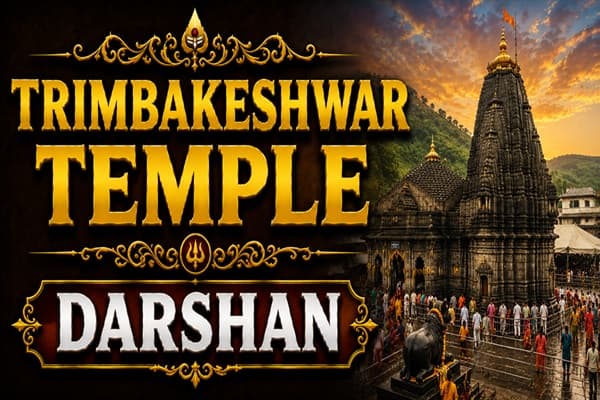
The Godavari River, the longest river in South India, begins its journey not from a mighty glacier or a large lake. It begins from a small kund, a tank, at the foothills of Brahmagiri Hills in a town called Trimbak. The water is clear, cool, and believed to be sacred. Standing at Kushavarta Kund, watching the water bubble up from the earth, you are standing at the source of one of India’s holiest rivers. And just a few steps away, carved entirely from black stone, stands the Trimbakeshwar Temple, one of the twelve Jyotirlingas of Lord Shiva.
Unlike other Jyotirlingas where the Shiva Linga is a single stone, Trimbakeshwar is unique. The Linga here has three faces, representing Lord Brahma, Lord Vishnu, and Lord Shiva. The three gods are united in one form. This is the only Jyotirlinga in India with this distinction. Devotees come here not just for the darshan, but for the rituals. Pinddaan for ancestors. Abhishekam with river water. The belief is strong. Prayers offered here reach all three deities at once.
Daily Darshan Timings for 2026
The temple opens at 5:30 AM. Regular darshan runs from 5:30 AM to 12:30 PM. The temple then closes for an afternoon break from 12:30 PM to 4:30 PM. Evening darshan runs from 4:30 PM to 8:30 PM. The temple closes at 9:00 PM.
The best time for a peaceful darshan is early morning between 5:30 AM and 7:00 AM. The crowd is thin. The air is cool. The rituals are just beginning. The priests chant the morning prayers. The temple feels alive but not crowded.
VIP darshan timings are slightly different. VIP pass holders can enter from 5:00 AM to 12:00 PM and from 3:00 PM to 7:00 PM. The VIP queue is separate and moves much faster. On normal days, the regular queue takes one to two hours. The VIP queue takes fifteen to thirty minutes. On festival days like Mahashivratri and Shravan Mondays, the regular queue stretches to four to six hours. The VIP queue still moves within one to two hours.
Abhishekam Darshan, the special ritual where the Linga is bathed, happens only in the early morning from 5:00 AM to 7:00 AM. This is a separate ticket. You do not just enter for darshan. You participate in the ritual. You watch as the priests pour milk, curd, honey, ghee, and water over the three faced Linga. The mantras, the smell of the offerings, the sight of the sacred liquids flowing over the black stone, it stays with you for days.
Daily Rituals and Puja Schedule
The temple follows a strict daily schedule of rituals. These rituals are not for show. They are performed with the same discipline every day, regardless of the number of devotees.
At 5:30 AM, the temple opens. The first darshan begins. At 7:00 AM, Brahma Puja starts and continues until 8:30 AM. This is the morning worship. The priests offer flowers, incense, and lamps to the deity.
At 10:45 AM, Mahadev Puja begins and continues until 12:30 PM. This is the main midday ritual. The Linga is decorated. Offerings of food are made. This is the best time for devotees who want to witness elaborate rituals.
At 1:00 PM on select days, a special afternoon puja is performed. This varies. Check with the temple office if you are interested.
At 4:30 PM, the Shiva Golden Crown Ritual, also called the special ceremony, happens. The deity is adorned with a golden crown. The sight of the three faced Linga with the gold crown glinting in the evening light is beautiful.
At 7:00 PM, Vishnu Aarti begins and continues until 8:30 PM. This is the evening prayer. The temple is lit with lamps. The chants fill the hall. The atmosphere is devotional but calm.
The temple closes at 9:00 PM after the night aarti.
VIP Darshan Pass: Is It Worth the Cost
The VIP Darshan Pass costs 200 rupees per person. You can book it online through the official temple website. The pass gives you entry through a separate gate, a shorter queue, and a faster darshan.
On a regular weekday, the difference between regular and VIP might be thirty minutes versus fifteen minutes. Not a huge difference. On a festival day, the difference is three hours versus one hour. That is a significant difference. For families with young children, for elderly devotees, for anyone traveling from far away with limited time, the VIP pass is worth every rupee.
The pass does not change the nature of the darshan. You still bow before the same Jyotirlinga. You still receive the same blessings. The only difference is the amount of time you spend standing in a queue.
Group VIP passes are available for groups of ten or more. The cost drops to 150 rupees per person. This is ideal for temple tour groups or large families.
How to Book Online Step by Step
Online booking is the most reliable method. The official website is maintained by the temple trust. Do not use any other site.
First, open the official website. Look for the Darshan Booking or Ticket Booking section. Click on it.
Second, select your darshan type. Regular darshan is free. VIP darshan costs 200 rupees. Abhishekam darshan has a separate fee.
Third, enter your personal details. Name, age, address, mobile number. The name must match your ID proof exactly. Any mismatch will result in entry denial.
Fourth, choose your date and time slot. Morning slots are more popular. Afternoon slots have less crowd. If you are booking for a festival day, book as soon as the window opens. Slots disappear within hours.
Fifth, complete the payment for VIP darshan. The website accepts UPI, debit cards, credit cards, and net banking. Regular darshan does not require payment, but you still need to fill the registration form to get a free pass.
Sixth, download your e ticket. Take a screenshot. Save it on your phone. Take a physical printout if possible. Network connectivity in Trimbak can be poor, especially on festival days. Having an offline copy is essential.
On the day of your visit, report to the VIP entry gate at least fifteen minutes before your scheduled time. Carry your e ticket and original ID proof. The security staff will verify both.
Best Time to Visit
The best time to visit Trimbakeshwar is from October to February. The weather in Nashik district is cool and pleasant. The daytime temperature ranges from 20 to 30 degrees Celsius. The nights are cool. Standing in queues is bearable. Walking around the temple town is enjoyable.
The Shravan month, July to August, is the most spiritually significant period. Every Monday in Shravan is considered highly auspicious for Lord Shiva. The temple is packed. The queues are long. The energy is intense. If you plan to visit during Shravan, book your VIP pass at least two weeks in advance. Do not expect to walk in and get a regular darshan within an hour.
Mahashivratri falls on 26 February 2026. This is the biggest festival at Trimbakeshwar. The temple stays open all night. Devotees pour in from across Maharashtra and beyond. Accommodation in Trimbak becomes impossible to find. Book your rooms and your darshan passes months in advance.
Summer, from March to May, is hot. Temperatures cross 40 degrees Celsius. The crowd is thinner. The queues are shorter. But the heat is punishing. If you visit in summer, come at 5:30 AM and finish your darshan by 8:00 AM. Spend the rest of the day indoors.
The Sacred Rituals You Can Perform
Pinddaan is the most important ritual performed at Trimbakeshwar. It is done at Kushavarta Kund, the source of the Godavari River. The ritual is for ancestors. You offer rice balls, water, and prayers to the souls of your departed family members. The belief is that performing Pinddaan here, at the source of the holy river, brings peace to the ancestors and blessings to the living.
The ritual requires a priest. Priests are available at the kund. They speak Marathi and Hindi. Some speak English. The cost varies. A basic Pinddaan costs 500 to 1,000 rupees. Elaborate rituals cost more.
Rudrabhishek is the bathing of the Shiva Linga. You can book this ritual at the temple counter. The priest chants the Rudram, a powerful hymn from the Yajur Veda, while pouring milk, curd, honey, ghee, and water over the Linga. The cost starts from 500 rupees.
Laghu Rudra is a more elaborate fire ritual. It costs between 5,000 and 8,000 rupees. The ritual takes about two hours. It is usually performed by a group of priests.
Mahamrityunjaya Puja is performed for health and protection from death. The cost is between 1,000 and 2,000 rupees. The priest chants the Mahamrityunjaya mantra 108 times.
How to Reach Trimbakeshwar
Trimbakeshwar is located in Trimbak town, Nashik district, Maharashtra. The temple is about 28 kilometers from Nashik city.
By train, the nearest railway station is Nashik Road, about 40 kilometers away. Trains from Mumbai, Pune, and Delhi connect to Nashik Road. From the station, take a taxi or bus to Trimbak. The drive takes about one hour.
By air, the nearest airport is Nashik Ozar Airport, about 50 kilometers away. Flights from Mumbai and other major cities connect to Nashik. From the airport, take a taxi.
By road, Trimbakeshwar is connected to Nashik, Mumbai, and Pune by National Highway 60. From Mumbai, the drive is about 170 kilometers and takes four hours. From Pune, the drive is about 220 kilometers and takes five hours. The roads are in good condition. Parking is available near the temple.
Where to Stay
Trimbak is a small town. Accommodation options are limited. The temple trust runs a few guest houses. The rooms are basic but clean. A bed, a fan, an attached bathroom. The cost is 500 to 1,000 rupees per night. Book in advance, especially during festival seasons.
Private hotels in Trimbak are also basic. Prices range from 1,000 to 2,000 rupees per night. Do not expect luxury. The town is a pilgrimage destination, not a tourist resort.
If you prefer better accommodation, stay in Nashik city. Nashik has hotels ranging from budget to premium. Prices start from 1,500 rupees per night and go up to 5,000 rupees. From Nashik, drive to Trimbak early in the morning. The drive takes about one hour.
Also Read : Sabarimala Temple 2026-27: Opening Dates, Darshan Timings, Online Booking
Dress Code and Rules
The temple expects traditional and modest clothing. Men should wear dhotis or kurtas. Full length trousers with shirts are acceptable. Shorts and sleeveless shirts are not allowed.
Women should wear sarees or salwar suits. Western dresses, sleeveless tops, and short skirts are not permitted.
Remove your footwear before entering the temple premises. Shoe stands are available. Do not carry leather items like belts or wallets inside.
Mobile phones are allowed but must be switched to silent mode. Do not take calls inside the temple. Photography is restricted inside the sanctum.
Maintain silence. Do not push or rush in the queues. The temple is small. The crowd is large. Patience is necessary.
The Three Faced Linga
Stand before the Linga. Look closely. You will see three faces carved into the black stone. One face represents Brahma, the creator. One face represents Vishnu, the preserver. One face represents Shiva, the destroyer. The three are separate, but they are also one. This is the core of Hindu philosophy. Creation, preservation, and destruction are not separate events. They are a cycle. They are all part of the same divine process.
The Linga is not large. It sits in a small sanctum. The priests control the crowd. You get only a few seconds to look. But those seconds are enough. The faces are clear. The eyes are wide. The stone is ancient. The energy is present.
Devotees pour water and milk over the Linga. The liquid flows down the black stone, catching the lamp light. The chant of Om Namah Shivaya fills the small space. Your ears ring. Your chest tightens. And then you are pushed out. The next devotee takes your place. You walk out into the sun, blinking. The town is noisy. The vendors are shouting. But something has quieted inside you. The three faced Linga has done its work.