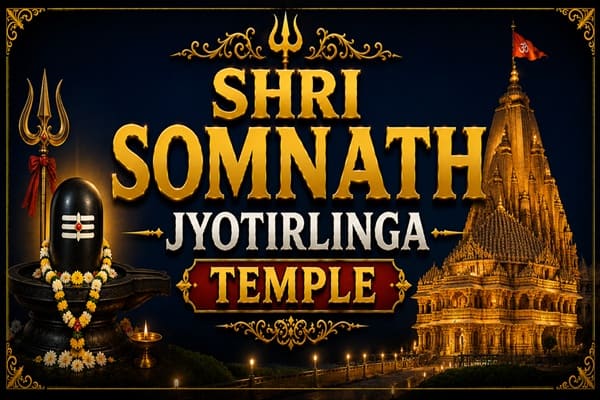
The first light hits the sandstone walls. The Arabian Sea crashes against the rocks below. The towering shikhara, the temple spire, reaches 150 feet into the sky. This is Somnath, the first among the twelve Jyotirlingas. The temple where the Moon God himself prayed to Lord Shiva. The shrine that has been destroyed and rebuilt multiple times, yet stands today as a symbol of faith that refuses to die.
Located in Prabhas Patan, near Veraval in Gujarat, this temple sits at the edge of the sea. The name Somnath means Lord of the Moon. According to legend, Chandra, the Moon God, was cursed to lose his brightness. He came to this spot, made a lingam out of sand, and prayed to Lord Shiva. Impressed by his devotion, Shiva removed the curse. The moon waxes and wanes, but the temple remains eternal.
This guide covers everything you need. Darshan timings, aarti schedules, VIP darshan booking, seva options, how to reach, nearby attractions, and practical tips. Read carefully before you plan your pilgrimage.
Why Somnath Is Called the Shrine Eternal
The history of this temple stretches back thousands of years. The Rig Veda mentions this sacred site. Legends say the Moon God first built the temple in gold. Ravana built it in silver. Lord Krishna built it in wood. The final stone structure was built by Bhimdeva. Each layer of construction represents a different era of devotion.
The temple faced destruction six times. Invaders came from the north. They broke the lingam. They looted the treasures. They killed the priests and devotees. But each time, the temple rose again. The faithful rebuilt it. Stronger. Larger. More magnificent. This cycle of destruction and reconstruction earned Somnath the title, the Shrine Eternal.
The current structure was rebuilt in 1951. The design follows the Chalukya style of architecture. The carvings on the walls tell stories from the Puranas. The pillars are intricately decorated. The sanctum houses the Jyotirlinga, a swayambhu, or self manifested, lingam. Devotees believe that a magnetic field around the linga keeps it floating slightly above the ground.
The Banastambha, the Arrow Pillar, stands at the sea edge. An inscription on it says that there is no land in a straight line between this point and Antarctica. This inscription proves the ancient knowledge of geography. The pillar serves as a reminder that Somnath has always been a place of learning as well as worship.
Daily Darshan Timings You Need to Know
The temple opens at 6:00 AM every day. Morning hours from 6:00 AM to 8:00 AM offer the most peaceful experience. The crowd is thin. The air is cool. You can stand before the lingam without feeling rushed. This is the best time for meditation and quiet prayer.
From 8:00 AM to 12:00 PM, the crowd grows. Families arrive. School groups visit. The queue moves steadily but waiting time increases. Mid day hours from 12:00 PM to 4:00 PM see the highest footfall. The sun is hot. The stone floors warm up. If you visit during these hours, carry water and wear comfortable clothing.
Evening hours from 4:00 PM to 7:00 PM bring the evening rush. People finish work and come for darshan. The energy changes. The temple becomes lively. The final hour from 7:00 PM to 9:00 PM is for the aarti. The crowd peaks during this time. The temple closes at 10:00 PM.
The average darshan takes 30 minutes to one hour on normal days. During weekends and festivals, waiting time can stretch to two or three hours. Weekdays are significantly less crowded. Tuesday mornings are the most peaceful. Monday, being Shiva’s day, sees more devotees.
Aarti Schedule for 2026
The temple holds four aartis every day. Each aarti has its own mood and meaning. Mangala Aarti starts at 7:00 AM. This is the morning wake up ritual for the deity. Priests chant mantras. Lamps are lit. The sanctum fills with the sound of bells. The atmosphere is calm and meditative.
Madhyanha Aarti takes place at 12:00 PM. This is the midday offering. The ritual is shorter, lasting about 20 minutes. The temple is busier at this hour. But the aarti still carries a peaceful energy.
Sandhya Aarti happens at 7:00 PM. This is the grand evening ceremony. Hundreds of lamps are lit. The priests perform elaborate rituals. Devotees fill every corner of the temple complex. The sound of conch shells and bells echoes off the stone walls. This aarti attracts the largest gathering. Arrive at least 30 minutes early to get a good spot.
Shayan Aarti takes place at 8:00 PM. This is the night ritual, putting the deity to rest. The atmosphere becomes quiet again. Many devotees prefer this aarti for its peaceful ambiance. The crowd thins out after Sandhya Aarti, leaving room for quiet prayer.
VIP Darshan Tickets and Booking
Waiting in long queues can be exhausting, especially for elderly devotees and families with young children. VIP darshan offers a solution. You get faster entry through dedicated queues. Your waiting time drops from hours to 15 to 30 minutes.
Regular VIP darshan costs between 50 and 100 rupees on normal days. During festivals like Mahashivratri and Shravan month, prices rise to 150 to 200 rupees. Premium VIP access costs 200 to 250 rupees. This includes priority access and a special route to the sanctum.
Senior citizens and differently abled devotees get reduced rates. Group bookings for ten or more people cost about 75 rupees per person on regular days. Festival group rates are higher at around 175 rupees per person.
Booking online is the smartest way to secure your VIP pass. Visit the official website. Create an account if you are a new user. Select VIP Darshan from the booking menu. Choose your preferred date. The calendar shows availability for the next 30 days. Green dates have slots. Red dates are full.
Enter the details of all devotees. Name, age, and ID proof number are required. The information must match your ID proof. Complete the payment using UPI, credit card, debit card, or net banking. Download the e ticket. Take a screenshot. Keep a printed copy as well. Arrive at the temple at least 30 minutes before your slot.
On site booking is also available at the temple counter. But availability is not guaranteed. Weekends and festival periods see high demand. Online booking is always the safer choice.
Seva and Special Rituals
Participating in a seva deepens your spiritual experience at Somnath. Rudrabhishek is the most popular ritual. Priests bathe the Shiva Linga with milk, curd, honey, ghee, sugar, and holy water. Vedic mantras are chanted throughout. The ceremony lasts 45 to 60 minutes. Prices range from 500 to 1,500 rupees.
Kaal Sarp Dosh Nivaran Puja is for devotees suffering from this specific planetary affliction. The ritual involves special mantras and offerings. The goal is to remove obstacles in career, marriage, and health. Prices start at 1,500 rupees and go up depending on the complexity of the ceremony.
Rin Mukti Puja is for those burdened by debt. The ritual seeks Lord Shiva’s blessings for financial freedom. Devotees who have performed this puja report gradual clearing of loans and new income sources appearing. The cost ranges from 1,000 to 2,500 rupees.
Navagraha Shanti Puja balances the energies of the nine planets. When planets are in bad positions in your horoscope, life becomes difficult. This puja reduces obstacles in work, health, and relationships. Prices vary based on the number of priests involved.
Maha Mrityunjay Jaap is for health and longevity. The powerful mantra is chanted 108 or 1,008 times. Devotees perform this for sick family members or for overall protection. Cost ranges from 1,000 to 2,500 rupees.
Advance booking for sevas is not always available. Reach the temple the evening before and book at the seva counter. Arrive early in the morning for your ritual slot. During Shravan month and Mahashivratri, book at least two days in advance.
Light and Sound Show
The light and sound show runs daily from 8:00 PM to 9:00 PM. The open air amphitheater offers a beautiful view of the illuminated temple. The show narrates the history of Somnath, its destruction, and its reconstruction. Visual effects and dramatic music bring the story to life.
Tickets cost between 30 and 50 rupees. No advance booking is available. Purchase tickets at the counter on the day of the show. Arrive 15 to 20 minutes early to secure good seating. The show is in Hindi and Gujarati on alternating days. English shows may be arranged for international tourists upon prior request.
The show is cancelled during heavy monsoon rains. Check the weather before planning your evening. Children and history enthusiasts particularly enjoy this experience.
How to Reach Somnath Temple
By train, the nearest station is Somnath Railway Station, just 0.5 kilometers from the temple. You can walk or take an auto rickshaw. Veraval Junction is 7 kilometers away and has better connectivity. Regular trains run from Ahmedabad, Rajkot, and Mumbai. The Somnath Express from Ahmedabad takes about 8 to 9 hours.
By air, the closest airport is Diu Airport, 85 kilometers away. Flights operate on limited days. Diu connects to Mumbai. From the airport, take a taxi. The drive takes about two hours. Rajkot Airport is 195 kilometers away with daily flights from major cities. Ahmedabad Airport is 400 kilometers away with the best connectivity.
By road, Somnath lies on National Highway 51. Gujarat State Road Transport Corporation runs regular buses from Ahmedabad, Rajkot, Surat, and Vadodara. Private taxis and app based cabs are also available. The drive from Ahmedabad takes 7 to 8 hours. From Rajkot, 4 to 5 hours. The roads are excellent.
Nearby Attractions to Complete Your Pilgrimage
Triveni Sangam is just 2 kilometers from the temple. This is the confluence of three sacred rivers, Hiran, Kapila, and the mythical Saraswati. A dip here is considered highly purifying. The sangam opens into the sea. The view at sunset is beautiful. Many devotees visit before entering the temple.
Bhalka Tirth is 3 kilometers away. This marks the spot where Lord Krishna was struck by an arrow. The hunter Jara mistook his foot for a deer. Krishna forgave him and then left his earthly body. A small temple marks the site. A footprint of Krishna is preserved here.
The Somnath Beach is adjacent to the temple. The water is not safe for swimming due to strong currents. But the beach is perfect for evening walks. Camel rides are available. Local vendors sell snacks and souvenirs. The sound of the waves adds to the peaceful atmosphere.
Gir National Park is 65 kilometers away. This is the only place in the world where you can see Asiatic lions in the wild. A full day trip from Somnath is possible. Start early morning. Return by evening. The park remains closed from June to October.
The Prabhas Patan Museum, run by the Archaeological Survey of India, is on the temple grounds. The museum displays sculptures and artifacts found during excavations. Ancient inscriptions, lintels, and carvings are on display. The museum opens from 10:00 AM to 5:00 PM. Closed on Fridays.
Best Time to Visit Somnath
The best months to visit are October to March. The weather is pleasant. Daytime temperatures range from 20 to 30 degrees Celsius. Evenings are cool. The sea breeze is refreshing. This is the peak tourist season. The temple is busier, but the comfortable weather makes up for it.
Shravan month, which falls in July and August, is the most auspicious time for Shiva devotees. The temple sees huge crowds. The energy is intense. Special rituals and abhishekams are performed daily. If you enjoy festival atmospheres, visit in Shravan. If you prefer quiet, avoid this month.
Mahashivratri, usually in February or March, is another peak time. The temple stays open late. Night long chanting and rituals happen. Thousands gather for the celebration. Book your VIP darshan and accommodation months in advance.
Avoid the summer months of April to June. Daytime temperatures exceed 40 degrees Celsius. The stone floors become hot. The walk from the parking area to the temple is exhausting. If you must visit in summer, come only for the early morning darshan between 6:00 AM and 8:00 AM.
Dress Code and Rules
Modest traditional clothing is required. Men should wear kurta pajama, dhoti, or formal trousers with a shirt. Shorts and sleeveless tops are not allowed. Women should wear sarees or salwar suits. Revealing clothing is prohibited.
Footwear must be removed before entering the temple premises. Shoe stands are available near the entrance. The fee is minimal. Keep the token. Some devotees carry their shoes in a cloth bag to avoid the counters.
Mobile phones and cameras are not allowed inside the sanctum. Lockers are available for storing electronics and bags. The cloakroom is free. Leather items like belts and wallets are also prohibited. Leave them in your vehicle or hotel room.
Photography is restricted inside the temple. Security personnel enforce this rule strictly. Maintain silence in the prayer halls. Do not push in the queue. Follow the instructions of the priests and security staff.
Also Read : Konark Sun Temple Light and Sound Show 2026: Timings, Online Booking
Accommodation Options
The Shree Somnath Trust manages several guesthouses. Sagar Darshan Atithi Grah, Lilavati Atithi Bhavan, and Maheshwari Atithi Bhavan offer clean, basic rooms. Prices range from 300 to 1,500 rupees per night. Rooms are allotted on a first come, first served basis. Online booking is available through the official website.
Private hotels are abundant near the temple complex. The Fern Residency Somnath offers 56 rooms with modern amenities. Prices start at 3,000 rupees per night. The Divine Resort has a swimming pool and conference rooms. Lords Inn Somnath offers airport pickup and spa services. Budget lodges charge 800 to 1,500 rupees per night.
During Shravan month, Mahashivratri, and the October to March peak season, book your accommodation at least two weeks in advance. Walk in availability is very limited during these periods.
Travel Tips for a Smooth Visit
Start your day early. The morning hours between 6:00 AM and 8:00 AM are the most peaceful. Complete your darshan before the crowd builds. Then explore the temple complex, visit the museum, and walk to the Triveni Sangam.
Carry a valid ID proof. You need it for VIP darshan verification. Aadhar card works best. Passport, voter ID, and driver’s license are also accepted. Keep the original with you. Photocopies and digital images are not sufficient.
Wear comfortable shoes. You will walk considerable distances within the complex. The parking area to the temple entrance is a 10 minute walk. The museum and Triveni Sangam require additional walking.
Stay hydrated. Carry a water bottle. Refill at the drinking water stations inside the complex. The Gujarat heat can be intense, even in winter. Dehydration causes fatigue and dizziness.
Avoid carrying large bags. Lockers are available but limited. Leave suitcases at your hotel. Carry only your essentials in a small waist pouch.
Book VIP darshan online at least one week in advance. Weekend slots fill quickly. Festival slots sell out within hours of release. Plan ahead to avoid disappointment.
Respect the temple rules. The sanctity of this ancient place depends on the cooperation of every visitor. Your small acts of respect make the experience better for everyone.
Conclusion
Somnath is not just the first Jyotirlinga. It is a testament to the resilience of faith. The temple has been destroyed and rebuilt multiple times. Each reconstruction was an act of devotion. Each stone placed was a prayer. Standing before the lingam, with the sound of the sea in the background, you feel the weight of that history.
Plan your visit carefully. Use the online booking system. Arrive early. Follow the rules. And when you finally stand before Lord Somnath, take a moment. Close your eyes. The same energy that heard Chandra’s prayer a thousand years ago is still here. It will not fail you.