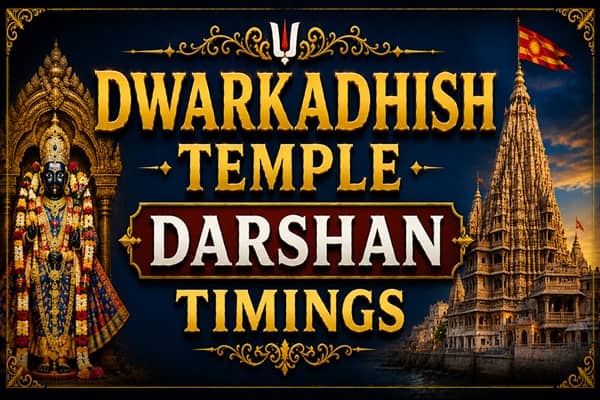
The morning light touches the five storey spire. The Gomti River flows quietly beside the temple walls. 72 carved pillars rise toward the sky, holding up a structure that has stood for over 2,000 years. This is Dwarkadhish Temple, the home of Lord Krishna as the King of Dwarka. Not just a temple. A gateway to the divine.
Located in Dwarka, Gujarat, this temple is one of the four sacred sites of the Char Dham Yatra. Pilgrims from across India and the world come here to complete their spiritual journey. The temple is also counted among the Sapta Puris, the seven holy cities of Hinduism. Its ancient walls have witnessed centuries of devotion. And today, the rituals continue without interruption.
This guide covers everything you need. Darshan timings, aarti schedules, bhog offerings, seva booking, ticket prices, and practical tips. Read carefully before you plan your visit.
The Temple That Holds Krishna’s Kingdom
Dwarka was the legendary kingdom of Lord Krishna. After he left Mathura, he established his capital here. The city was built on land reclaimed from the sea. It was said to be made of gold and precious stones. The current temple stands on the same sacred ground.
The temple is known as Jagat Mandir, meaning the temple of the world. The black stone statue of Lord Krishna stands four feet tall. He is worshipped as Dwarkadhish, the King of Dwarka. His form holds a mace, a discus, a conch, and a lotus. These symbols represent his divine powers as the ruler of the universe.
The temple architecture follows the Māru Gurjara style. The five storey shikhara, the spire, rises 157 feet high. The 72 pillars support the structure, each intricately carved. The flag on top is changed multiple times a day. Devotees believe that seeing the flag brings special blessings.
Daily Darshan Timings You Must Know
The temple follows a detailed schedule with multiple breaks for rituals. Knowing the exact timings prevents disappointment. Do not arrive during bhog offerings. The sanctum doors remain closed during those periods.
Mangla Aarti starts at 6:30 AM. This is the first ritual of the day. The temple opens for Mangla Darshan from 7:00 AM to 8:00 AM. This is the best time for a peaceful darshan. The crowd is thin. The morning air is cool. You can stand before the deity without being rushed.
Abhishek, the Snan Vidhi, happens from 8:00 AM to 9:00 AM. Darshan is closed during this ritual. Priests bathe the idol with milk, curd, honey, and holy water. The first Shringar Darshan follows from 9:00 AM to 9:30 AM. You see the deity being dressed in fresh clothes and jewelry.
Snan Bhog closes the temple from 9:30 AM to 9:45 AM. The second Shringar Darshan runs from 9:45 AM to 10:15 AM. Shringar Bhog closes the temple from 10:15 AM to 10:30 AM. Shringar Aarti happens from 10:30 AM to 10:45 AM. Devotees can attend this aarti.
Gwal Bhog closes the temple from 11:05 AM to 11:20 AM. First General Darshan runs from 11:20 AM to 12:00 PM. Rajbhog Offering closes the temple from 12:00 PM to 12:20 PM. Second General Darshan runs from 12:20 PM to 12:30 PM.
The temple closes completely at 1:00 PM. The afternoon break lasts until 5:00 PM. Do not arrive during these hours. You will find locked doors.
Evening session starts at 5:00 PM with Uthapan Darshan. The temple remains open for evening darshan and bhog offerings until 9:30 PM. Evening aarti happens at 7:30 PM. This is the most attended ritual. The temple fills with devotees. The sound of bells and conch shells echoes across the complex. Shayan Aarti at 8:30 PM marks the closing rituals.
The temple closes at 9:30 PM. Security ensures all visitors exit by this time.
Aarti Schedule for 2026
Four aartis happen daily at Dwarkadhish Temple. Each carries its own significance and energy.
Mangla Aarti at 6:30 AM is the morning wake up ritual. The deity is gently woken. Priests chant mantras in the dim light. The atmosphere is calm and meditative. Devotees who attend this aarti describe a deep sense of peace.
Shringar Aarti at 10:30 AM happens after the deity has been dressed and adorned. The idol looks magnificent in silk and gold jewelry. The aarti is shorter but visually stunning. This is a good time for photography. The temple is not too crowded at this hour.
Sandhya Aarti at 7:30 PM is the grand evening ceremony. Hundreds of lamps are lit. The priests perform elaborate rituals. The entire temple complex vibrates with devotional energy. This aarti attracts the largest gathering. Arrive at least 30 minutes early if you want to see it from the front.
Shayan Aarti at 8:30 PM puts the deity to rest. The rituals are quieter. The crowd thins out. Many devotees prefer this aarti for its peaceful atmosphere. The temple closes shortly after.
Seva and Bhog Offerings
General darshan at Dwarkadhish Temple is completely free. You can walk in without paying anything. The queue moves steadily on normal days. But free darshan comes with long waits on weekends and festivals.
For a faster experience, Special Entry tickets cost 200 rupees. This gets you quicker access through a separate queue. Premium donor access costs 500 rupees. This includes priority entry and a better viewing position near the sanctum.
Bhog offerings are for devotees who want to participate in feeding the deity. Mangla Bhog costs 1,101 rupees. Makhan Misri offering, Krishna’s favourite, costs 701 rupees. Snan Bhog, the bathing offering, costs 2,101 rupees. Shringar Bhog, the dressing offering, costs 3,101 rupees.
Madhyan Gwal Bhog costs 2,501 rupees. Raj Bhog, the main meal offering, costs 3,501 rupees. Banta Bhog costs 1,001 rupees. Utthapan Bhog costs 1,151 rupees. Sandhya Bhog costs 3,151 rupees. Shayan Bhog costs 1,551 rupees. Shayan Banta Bhog costs 1,151 rupees.
For a complete experience, the Full Day Bhog package includes all four aartis, morning and evening rituals. This costs 21,001 rupees. The Morning Combo with seven bhog offerings costs 14,001 rupees. The Evening Combo with four bhog offerings costs 7,001 rupees.
Booking these sevas online through the official website is the smartest way. Visit dwarkadhish.org. Select Online Bhog Seva Booking. Choose your offering. Enter your details and ID proof. Complete the payment. Download the confirmation slip. Show it at the temple counter on the day of your visit.
Is VIP Darshan Available at Dwarkadhish Temple
The temple does not have an officially declared VIP Darshan system. You cannot buy a VIP ticket like at other temples. However, booking a bhog or seva offering effectively gives you priority access. You move through a separate queue. Your waiting time drops significantly.
Donor passes, starting at 500 rupees, also provide faster entry. These options work similarly to VIP access. Choose them during peak seasons and festivals. The extra cost is worth the time saved.
Best Time to Visit Dwarkadhish Temple
The best months are October to March. The weather is pleasant. Daytime temperatures range from 20 to 30 degrees Celsius. Evenings are cool. The sea breeze is refreshing. This is the peak tourist season. The temple is busier, but the comfortable weather makes up for it.
For a peaceful darshan, visit on weekdays. Tuesday through Thursday mornings have the lowest crowds. Saturday and Sunday see long queues. Monday, being Krishna’s day, also attracts more devotees.
The early morning hours from 7:00 AM to 8:00 AM are the best. The Mangla Darshan window offers a calm, uncrowded experience. You can stand before the deity without being rushed. The afternoon break from 1:00 PM to 5:00 PM should be avoided entirely.
Major festivals transform the temple into a vibrant spiritual hub. Janmashtami, Krishna’s birthday, sees thousands of devotees. The temple is decorated with flowers and lights. Special rituals and cultural programs happen throughout the day. Holi, the festival of colours, is celebrated with devotional songs and dances. Annakut, the mountain of food offering, happens after Diwali. Kartik Purnima, the full moon night, is considered highly auspicious.
These festivals attract huge crowds. The divine energy, decorations, and rituals make the experience unforgettable. But be prepared for long waiting times and limited parking. Book your sevas and accommodation months in advance.
How to Reach Dwarkadhish Temple
By train, the nearest station is Dwarka Railway Station, about 2 kilometers from the temple. Auto rickshaws charge 20 to 30 rupees for the trip. Walking takes 20 to 25 minutes. The station connects to major cities like Ahmedabad, Mumbai, and Delhi. The Saurashtra Mail and Okha Express run regularly.
By air, the nearest airport is Jamnagar Airport, 140 kilometers away. Jamnagar connects to Mumbai. From the airport, hire a taxi. The drive takes about three hours. Porbandar Airport is 95 kilometers away with limited flights. Ahmedabad Airport is 440 kilometers away with the best connectivity.
By road, Dwarka lies on National Highway 51. Gujarat State Road Transport Corporation runs regular buses from Ahmedabad, Rajkot, Jamnagar, and Porbandar. Private taxis and app based cabs are also available. The drive from Ahmedabad takes 8 to 9 hours. From Rajkot, 4 to 5 hours.
Accommodation Options
The temple trust manages several guesthouses. Rooms are basic but clean. Prices range from 300 to 1,500 rupees per night. Booking is available through the official website. Online reservations are recommended during peak season.
Private hotels range from budget lodges to luxury resorts. Budget options cost 800 to 1,500 rupees per night. Mid range hotels charge 2,000 to 4,000 rupees. Luxury properties go up to 8,000 rupees and above. Book at least two weeks in advance during October to March and during festivals.
Nearby Attractions to Complete Your Pilgrimage
Bet Dwarka is an island 30 kilometers from the main temple. Lord Krishna is believed to have lived here with his family. A ferry takes you across the sea. Small temples dot the island. The ride itself is beautiful. The sea views are stunning. Plan for a half day trip.
Nageshwar Jyotirlinga Temple is 17 kilometers away. This is one of the 12 Jyotirlingas of Lord Shiva. The temple has a massive 80 foot statue of Lord Shiva. The site is peaceful. Combine this visit with your Dwarka pilgrimage. Many devotees visit both on the same day.
Gomti Ghat is adjacent to the temple. The Gomti River meets the sea here. Taking a dip in the holy water is considered highly purifying. Small shrines line the ghat. The sunset view is beautiful. Visit after your darshan.
Rukmini Devi Temple is 2 kilometers from the main temple. Rukmini was Krishna’s chief queen. The temple is smaller but equally sacred. The carvings on the walls are exquisite. The atmosphere is quiet and peaceful.
Also Read : Somnath Temple 2026: Darshan Timings, VIP Ticket, Aarti Schedule, Seva Booking
Dress Code and Rules
Modest traditional clothing is required. Men should wear kurta pajama, dhoti, or formal trousers with a shirt. Shorts and sleeveless tops are not allowed. Women should wear sarees or salwar suits.
Footwear must be removed before entering the temple premises. Shoe stands are available near the entrance. The fee is minimal. Keep the token. Some devotees carry their shoes in a cloth bag to avoid the counters.
Mobile phones and cameras are not allowed inside the sanctum. Lockers are available for storing electronics. Leather items like belts and wallets are also prohibited. Photography is restricted inside the main temple. Security personnel enforce these rules strictly.
Maintain silence in the prayer halls. Do not push in the queue. Follow the instructions of the priests and security staff. The temple sees heavy crowds. Cooperation keeps the experience peaceful for everyone.
Visitor Tips for a Smooth Darshan
Arrive at least 30 minutes before your desired darshan time. The security check takes time. The queue builds faster than you expect. Being early prevents last minute rushing.
Carry cash. The shoe counters and small shops do not accept cards. ATMs are available nearby but can run out on festival days. Having 500 to 1,000 rupees in small denominations makes transactions smooth.
Drink water before entering. The Gujarat heat can be intense, even in winter. Carry a small water bottle. Refill at the drinking water stations inside the complex.
Do not bring large bags. Lockers are available but limited. Leave suitcases at your hotel. Carry only your essentials in a small waist pouch.
Book your sevas online at least two weeks in advance. Weekend slots fill quickly. Festival slots sell out within hours of release. The official website dwarkadhish.org is the only reliable source.
Contact Information
The temple address is Shree Dwarkadhish Temple, Dwarka 361335, Devbhoomi Dwarka, Gujarat. The phone number is 91 2892 234080. The email is dwarkadhishtemple@dwarkadhish.org. The official website is dwarkadhish.org. Call during business hours from 9:00 AM to 5:00 PM. The phone lines are busiest in the morning. Try calling in the early afternoon for better response.
Final Thoughts
Dwarkadhish Temple is not just another stop on the Char Dham circuit. It is the kingdom of Lord Krishna, preserved in stone and devotion. The rituals have continued for centuries without break. The flag has been raised and lowered countless times. The lamps have been lit every evening. That continuity is the real blessing of Dwarka.
Plan your visit carefully. Use the online booking system for sevas. Arrive early for Mangla Darshan. Stay for the Sandhya Aarti. Walk to the Gomti Ghat after the temple closes. And when you stand before the four foot black stone idol, remember. This is the same Krishna who lifted a mountain, played the flute, and spoke the Bhagavad Gita. He is still here. He has never left.