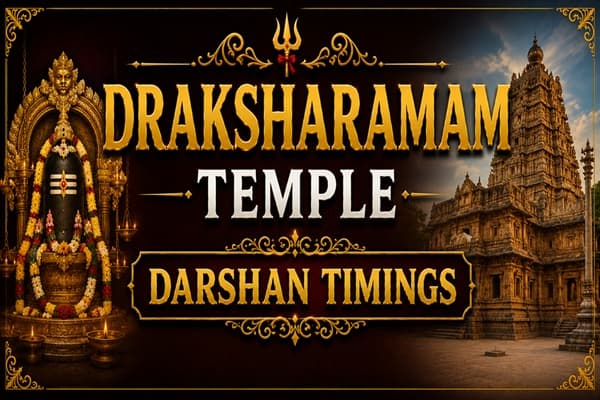
The morning light falls on the towering gopuram. A priest lights the first lamp. The sound of conch shells echoes through the corridors. This is Draksharamam, a temple that holds two rare distinctions. It is both a Pancharama Kshetra, dedicated to Lord Shiva, and a Shakti Peetham, where the left cheek of Goddess Sati fell. Few temples in India carry this double significance.
Located in the East Godavari district of Andhra Pradesh, near the town of Kakinada, this temple draws thousands of devotees every single day. The main deities are Lord Bhimeswara Swamy, a form of Shiva, and Goddess Manikyamba Devi. The temple sees heavy crowds on Mondays, during the month of Karthika, and on Maha Shivaratri. Planning your visit without knowing the timings leads to long waits and frustration. This guide covers everything you need. Timings, rituals, ticket prices, online booking, history, and travel tips. No fluff. Just clear, useful information.
The History That Makes This Temple Special
The Draksharamam temple history stretches back more than a thousand years. King Bhima of the Eastern Chalukya dynasty built the temple during the 9th to 10th century CE. His vision created a Shaivite center that remains active and vibrant even today.
Legends say that Lord Surya, the sun god, installed the Shiva Lingam here. This gives the lingam a special energy that devotees feel the moment they enter the sanctum. The temple also marks the spot where Sati’s left cheek fell after her father Daksha insulted Lord Shiva. This makes it one of the Ashtadasha Shakti Peethams, the eighteen most sacred sites for Goddess worship.
The temple walls carry inscriptions from different periods. Each carving tells a story. Each pillar holds centuries of prayers. Walking through the complex feels like moving through living history, not a museum.
The Architecture That Leaves You Speechless
The temple follows the classic Dravidian architectural style. Tall gopurams, the gateway towers, rise above the complex. Intricate carvings cover every available surface. Deities, mythological scenes, and floral patterns decorate the pillars and walls.
The most unusual feature is the two storied sanctum. Most temples have a single level inner chamber. Here, the sanctum has an upper floor, setting it apart from other Pancharama Kshetras. The spacious inner corridors allow for pradakshina, the ritual of walking around the deity.
Massive stone walls showcase the Eastern Chalukya craftsmanship. The builders used no mortar. Each stone was carved to fit perfectly with its neighbour. Centuries later, the structure remains strong and stable.
Daily Darshan Timings You Must Know
The temple follows a strict daily schedule. Morning darshan starts at 6:00 AM and continues until 12:00 PM. This is the best time for a peaceful visit. The crowd is thinner, the weather is cooler, and the morning light makes the carvings glow.
The temple closes from 12:00 PM to 3:00 PM. This midday break allows the deity to rest. Priests clean the sanctum and prepare for the evening rituals. Do not arrive during these hours expecting darshan. You will be turned away.
Evening darshan resumes at 3:00 PM and continues until 8:00 PM. The atmosphere becomes more energetic during these hours. Devotees finish work and come for prayers. Evening aarti happens at 7:00 PM, and the temple closes promptly at 8:00 PM.
During festivals like Maha Shivaratri and the month of Karthika Masam, the timings change. The temple opens as early as 5:00 AM and closes later than 8:00 PM. Some nights, especially on Maha Shivaratri, the temple stays open through the entire night. Check the official website before visiting during these periods.
Aarti and Pooja Schedule
The daily pooja schedule follows ancient Vedic traditions. Each ritual has its own significance and timing. Attending these ceremonies deepens your spiritual experience.
Abhishekam, the ritual bathing of the Shiva Lingam, happens between 6:00 AM and 9:00 AM on regular days. During Karthika Masam and Masa Shivaratri, the Abhishekam timings extend from 5:00 AM to 11:00 AM. Sacred substances like milk, curd, honey, ghee, and sugar are poured over the lingam while priests chant mantras. Many devotees consider attending Abhishekam the highlight of their visit.
Kumkum Archana for Goddess Manikyamba Devi takes place in two sessions. Morning session runs from 6:00 AM to 10:00 AM. Evening session runs from 3:00 PM to 8:00 PM. Women particularly seek this ritual for family wellbeing and prosperity. The priest offers red vermillion and flowers to the goddess while chanting your name and gotra.
Aarti happens three times daily. Morning Aarti starts at 7:00 AM. Afternoon Aarti is at 12:00 PM, just before the temple closes. Evening Aarti is at 7:00 PM. The evening ceremony is the most attended. The sight of multiple lamps waving in front of the deity, accompanied by bells and chants, creates a deeply moving experience.
Seva Ticket Prices for 2026
The temple offers several seva options at reasonable prices. Sarva Darshan, the general entry, is completely free. You can walk in without paying anything. The queue for free darshan moves steadily.
Suprabhatam, the early morning wake up ritual for the deity, costs 50 rupees. This happens before the temple officially opens. Devotees who book this seva witness the priests waking the deity with chants and offerings.
Regular Abhishekam costs 200 rupees. This includes the ritual bathing ceremony and prasadam. Special Abhishekam, a more elaborate version with additional sacred substances, costs 500 rupees. This is popular for devotees with specific wishes or during auspicious occasions.
Alankaram, the decoration seva, costs 150 rupees. Priests adorn the deity with fresh flowers and silk clothes. Aarti sponsorship costs 100 rupees. Your name is announced during the ceremony.
All sevas include priest services and blessed prasadam. The funds support temple maintenance and priest salaries. Book in advance during festival periods. Walk in availability is limited on crowded days.
How to Book Darshan and Sevas Online
The Andhra Pradesh temples online booking system makes planning easy. Start by visiting the official portal. Create an account using your mobile number. Set a password and verify your number with the OTP sent to your phone. The registration process takes less than five minutes.
Log into your account. Search for Sri Bhimeswara Swamy Temple, Draksharamam from the temple list. Select your preferred darshan or seva type. Choose your date and time slot. Morning slots between 6:00 AM and 9:00 AM are most popular. Afternoon slots are easier to get.
Enter the details of all devotees. Name, age, and gender are required. The information must match your ID proof. Upload a clear photo of your government ID. Aadhar card, passport, or driver’s license works. Review everything carefully before proceeding.
Complete the payment using credit card, debit card, UPI, or net banking. The payment gateway is secure. After successful payment, you receive a confirmation SMS and email. Download the e ticket. Take a printed copy or save it on your phone. Arrive at the temple at least thirty minutes before your slot.
The cancellation policy allows changes up to 48 hours before the booking. Refunds take seven to ten days. Service charges are non refundable. Emergency cancellations are considered case by case. Contact the temple office directly for assistance.
Festivals That Transform the Temple
Maha Shivaratri is the biggest festival here. The temple stays open all night. Thousands gather for continuous chanting and Abhishekam. Each hour, a different set of priests performs rituals. The energy builds as midnight approaches. Arrive early if you want a good spot. Online booking becomes mandatory during this festival.
Karthika Masam, the month of the deity, falls between October and November. The entire month sees special rituals. Devotees light oil lamps around the temple complex. Evening poojas extend longer. The crowd is heavy but manageable. The month end celebrations draw the largest numbers.
Navratri celebrates the goddess Manikyamba Devi. Nine nights of special Alankarams, decorations, and Aartis. Each night, the goddess wears a different outfit and jewellery. The cultural programs attract visitors who appreciate traditional music and dance.
Other important days include Sundays, Ekadashi, and Mondays. Monday is considered Lord Shiva’s day. The queue doubles or triples compared to weekdays. Plan accordingly.
How to Reach Draksharamam Temple
By train, the nearest station is Kakinada Town Railway Station, about thirty kilometers away. Samalkot Junction and Kakinada Port are also nearby options. From the station, auto rickshaws charge 150 to 200 rupees for the trip. Taxis cost 500 to 700 rupees. The drive takes about forty five minutes.
By air, Rajahmundry Airport is the closest, approximately fifty to fifty five kilometers away. Regular flights connect Rajahmundry to Hyderabad, Bangalore, and Chennai. From the airport, hire a taxi. The fare is around 1,500 to 2,000 rupees. The journey takes about one and a half hours.
By road, APSRTC buses run regularly from Kakinada, Rajahmundry, Amalapuram, and Visakhapatnam. Private buses also operate on these routes. The bus stand is near the temple, about a ten minute walk. If driving yourself, use the Yanam Road from Kakinada or the Kadiyam route from Rajahmundry. Parking space is available near the temple.
Where to Stay
The temple provides simple guest rooms. These are basic but clean. Rooms cost 200 to 500 rupees per night. The advantage is location. You wake up steps away from the temple entrance. Book through the temple office. Advance booking is essential during festivals.
Hotels in Kakinada offer more comfort. Air conditioned rooms cost 1,500 to 3,000 rupees. Budget options start at 800 rupees. Hotel Sri Krishna Residency and Hotel Srinivasa are popular choices. Samalkot also has several mid range hotels. Amalapuram offers economy stays for tight budgets.
During Maha Shivaratri and Karthika Masam, accommodation fills up weeks in advance. Do not expect walk in availability. Book online or call the hotel directly.
Also Read : Udupi Sri Krishna Temple 2026: Timings, History, Window Darshan, Poojas
Local Attractions Near the Temple
The Konaseema region, where Draksharamam sits, is known for its scenic beauty. The Godavari river flows nearby, creating lush green landscapes. Several other temples are within driving distance.
The Pancharama Kshetras, the five temples dedicated to Lord Shiva, are spread across Andhra Pradesh. Draksharamam is one of them. The other four are Amararama, Somarama, Ksheerarama, and Kumararama. Devotees often plan a circuit covering all five over several days.
Dress Code and Rules
Men should wear traditional clothing. Dhoti with a shirt or kurta is ideal. Pants are acceptable. Shorts are not allowed. Women should wear sarees or salwar kameez. Western outfits like jeans and sleeveless tops are not permitted.
Remove your footwear before entering the main complex. Shoe keeping counters charge 5 to 10 rupees. Keep the token. Some visitors carry their shoes in a cloth bag to save time.
Mobile phones are allowed but must be switched off inside. Photography is restricted in the inner sanctum. You may take pictures in outer areas. Respect the signs and the priests’ instructions. Cameras with large lenses are not permitted.
Maintain silence inside the prayer hall. The atmosphere demands respect. Speak softly or not at all. Children must stay with adults at all times. Do not touch the deity or the priests.
Best Time to Visit
Early morning, right after the 6:00 AM opening, is the best time. The crowd is thin. The air is cool. The morning light makes the carvings visible in detail. You can complete your darshan in thirty minutes instead of two hours.
Weekdays are better than weekends. Tuesday and Wednesday see the lowest footfall. Monday and Friday are crowded. Weekends, especially Sundays, see long queues. Avoid public holidays if possible.
The cool season from October to March is the most comfortable for travel. Summer months from April to June are very hot. The granite floors heat up. Walking barefoot becomes uncomfortable. If visiting in summer, come early morning or late evening.
Final Tips for a Smooth Visit
Reach at least thirty minutes before your booked slot. Security checks take time. Parking fills quickly. The queue builds faster than you expect.
Carry cash. The shoe counters, small shops, and some ticket windows do not accept cards. ATMs are available but may run out on festival days.
Drink water before entering. There are no water fountains inside the main complex. Outside stalls sell packaged water. Carry a small bottle that fits in your pocket.
Do not bring large bags. Lockers are available but limited. Leave suitcases at your hotel. The best strategy is to carry only your essentials in a small waist pouch.
Walk slowly. The temple deserves attention. Notice the carvings. Watch the priests. Listen to the chants. The rush to finish spoils the experience. Give yourself at least two hours inside the complex.
After darshan, sit for a while in the outer corridor. Close your eyes. Feel the energy of a place that has held prayers for over a thousand years. That quiet moment is the real blessing of Draksharamam.