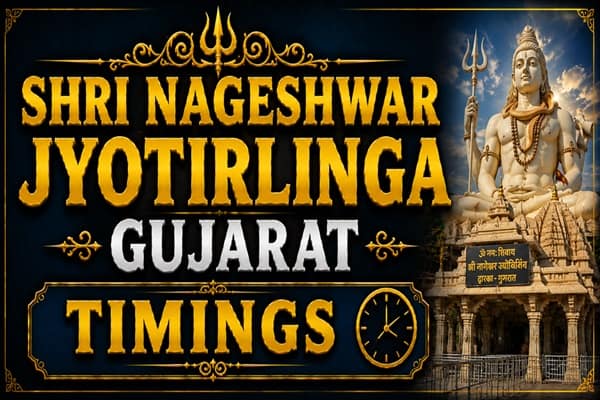
The Arabian Sea crashes against the rocks of the Saurashtra coast. The wind is salty. The air is warm. And hidden in the small village of Daarukavanam, about eighteen kilometers from Dwarka, stands a temple that guards one of the twelve Jyotirlingas. Nageshwar is not the largest temple. It is not the most crowded. But it is unique. The Linga sits in an underground sanctum, two feet below the ground level. You descend a few steps, and the temperature drops. The air becomes still. The energy shifts. And there, in the semi darkness, the Jyotirlinga, shaped like a three faced Rudraksha, waits for your prayers.
The name Nageshwar means Lord of Serpents. Not just snakes, but all poisons. Anger. Jealousy. Ego. Fear. The belief is that worshipping here removes spiritual poisons as surely as the temple protects from snake venom. The connection to Rudraksha is strong. The Linga itself is carved in the shape of a Tri Mukhi Rudraksha, the three faced bead. And the devotee who saved the Jyotirlinga from destruction, a merchant named Supriya, never stopped wearing his Rudraksha beads, even in prison.
Daily Darshan and Aarti Timings for 2026
The temple opens at 6:00 AM. Morning darshan runs from 6:00 AM to 12:30 PM. The best time for a peaceful, uncrowded darshan is early morning between 6:00 AM and 8:00 AM. The crowd is thin. The air is cool. The rituals are just beginning.
The temple closes for an afternoon break from 12:30 PM to 5:00 PM. Do not arrive during these hours. The gates will be locked. The priests will be resting.
Evening darshan runs from 5:00 PM to 9:30 PM. The evening aarti is at 7:00 PM. This is the most popular time to visit. The temple is lit with lamps. The priests chant. The crowd is larger, but the energy is devotional.
Morning aarti is at 5:30 AM, before the temple officially opens for darshan. This aarti is for early risers and serious devotees. The temple is dark. Only a few people are present. The experience is intimate.
Afternoon Shringar, the decoration ceremony, happens at 12:00 PM and again at 5:00 PM. The deity is dressed and adorned with flowers and jewels. This is a beautiful ritual to witness.
Abhishekam, the sacred bathing of the Linga, is performed from 6:00 AM to 12:30 PM. You can participate in this ritual by paying a small fee. The priest pours milk, water, honey, ghee, curd, and bilva leaves over the Linga while chanting mantras.
The Story of the Demon Daruka and the Devotee Supriya
The legend of Nageshwar is not about kings or gods. It is about a merchant and a demon. Daruka and his wife Daruki were powerful demons who lived in a forest called Daarukavanam, which was actually a city under the sea. They had received boons that made them nearly invincible. They terrorized the people, destroyed religious ceremonies, and captured anyone who opposed them.
One day, they captured a merchant named Supriya. Supriya was a devoted follower of Lord Shiva. He wore Rudraksha beads on his body. He applied holy ash. He chanted Om Namah Shivaya continuously. Even in the dark dungeon, surrounded by demons, he did not stop his prayers. He encouraged the other prisoners to chant with him.
Daruka grew tired of the noise. He decided to kill Supriya. But as he raised his weapon, Lord Shiva appeared in his divine form. The light of the Jyotirlinga filled the dungeon. The demons were vanquished. The prisoners were freed. And the Jyotirlinga that Supriya had worshipped with his unshakeable faith became eternal at that very spot.
The lesson of the story is simple. Faith is not about grand gestures. It is about persistence. Supriya did not defeat the demons with a weapon. He defeated them with a chant. He did not escape the dungeon. He transformed it. The Rudraksha on his body was not a decoration. It was a shield.
The Architecture and the South Facing Mystery
The temple is designed in the Maru Gurjara style, adapted for the coastal location. The walls are thick. The sandstone is porous, which resists salt erosion. The foundations are elevated to protect against high tides.
The layout is based on the human body in a sleeping posture. The main entrance represents the feet. The entry porch represents the hands. The main hall represents the abdomen. The sanctum represents the head. Walking through the temple is like walking through a body. You start at the feet, move through the hands and abdomen, and end at the head. The descent into the sanctum is the descent into consciousness.
Outside the temple stands a 125 foot tall statue of Lord Shiva in deep meditation. The statue is visible from the highway. It guides devotees to the entrance.
The Linga faces south. This is unusual. Most Shiva temples face east. The story goes that Sant Naamdev was singing bhajans in the temple when some devotees asked him to move aside. Naamdev asked them to show him one direction where Lord Shiva does not exist. The annoyed devotees dragged him to the southern side. The Linga miraculously turned to face south toward Naamdev.
Ticket Prices and Seva Options
General darshan is completely free. You can walk in during open hours and join the queue. The wait is usually fifteen to thirty minutes.
Abhishekam tickets range from 101 to 750 rupees, depending on the type of ritual. A basic Abhishekam with milk and water costs less. An elaborate Abhishekam with multiple offerings costs more. The priest guides the ritual. You can sit near the Linga and watch.
Aarti Thalis cost between 150 and 300 rupees. The thali contains flowers, incense, camphor, and a small lamp. You can purchase the thali from the counter inside the temple and offer it during the aarti.
During festivals like Mahashivratri, the temple offers VIP or Special Seva tickets. These are for priority darshan. The cost is higher. Book in advance.
Nearby Attractions You Should Not Miss
Dwarkadhish Temple is 17 kilometers away. This is the main Krishna temple in Dwarka. The spire rises high above the city. The evening aarti is spectacular. Do not miss it.
Rukmini Temple is 18 kilometers away. The temple is dedicated to Krishna’s chief queen. The architecture is beautiful. The surroundings are peaceful.
Bet Dwarka is 30 kilometers away. The island is believed to be the original residence of Lord Krishna. You need to take a boat from the mainland. The boat ride is short, about fifteen minutes. Keep your eyes open for dolphins.
Shivrajpur Beach is 35 kilometers away. The beach is clean and Blue Flag certified. You can walk on the sand, wade in the water, or just sit and watch the sunset.
Sudama Setu is 16 kilometers away. It is a pedestrian suspension bridge. The views from the bridge are stunning. Go at sunset.
Panchkui Tirth is 16 kilometers away. Five sacred wells are linked to the Pandavas. The site is quiet and less crowded.
How to Reach Nageshwar Temple
By road, Nageshwar is connected to Dwarka by National Highway 947. The drive from Dwarka takes about twenty five minutes. Taxis and auto rickshaws are readily available.
By train, the nearest railway station is Dwarka, about 18 kilometers away. Trains from Ahmedabad, Jamnagar, and other major cities connect to Dwarka. From the station, hire a taxi or take an auto.
By air, the nearest airports are Porbandar, 107 kilometers away, and Jamnagar, 130 kilometers away. Both airports have flights from Mumbai and other major cities. From the airport, hire a taxi.
The temple address is 83pp+9RJ, Daarukavanam, Goriyali, Gujarat 361345.
Best Time to Visit
October to February is the best time to visit. The weather is pleasant. The temperatures range from 15 to 25 degrees Celsius. The humidity is low. The sea breeze is refreshing.
During the summer months of March to May, the heat is intense. Temperatures cross 35 degrees Celsius. The afternoon sun is punishing. The temple remains open, but waiting in the queue becomes uncomfortable.
The monsoon season, from June to September, brings heavy rain. The temple remains open, but the roads can be wet and slippery. The sea is rough.
Mahashivratri, which falls in February or March, is the biggest festival at the temple. The temple is packed. The queue stretches down the road. If you plan to visit during Mahashivratri, book your travel and accommodation months in advance.
Also Read : Babulnath Temple: Timings, Aarti Schedule, VIP Darshan & History
Where to Stay and Eat
Hotels near the temple range from budget lodges at 1,000 rupees per night to luxury resorts at 6,000 rupees per night. Hawthorn Suites by Wyndham and Lemon Tree Premier are good options for comfortable stays. Madhuvan Suites and Dwarkadhish Lords Eco Inn are more budget friendly.
The Fern Sattva Resort, about 5,000 rupees per night, offers a peaceful stay with good amenities.
Restaurants in the area serve Gujarati thalis, Kathiyawadi cuisine, North Indian dishes, and Chinese. Vraj Restaurant is famous for its Kathiyawadi food. Dwarkadhish Dhaba serves a good Punjabi thali. Kant Dining Hall offers a mix of Gujarati and South Indian dishes.
Most restaurants are pure vegetarian. The food is simple, filling, and affordable.
The Deeper Meaning of the Jyotirlinga
The twelve Jyotirlingas are not separate deities. They are the same Shiva, appearing in different places. The light is the same. The energy is the same. But each place teaches a different lesson. Somnath teaches resilience. Kashi Vishwanath teaches liberation. Nageshwar teaches protection.
The demon Daruka lived under the sea. The city of Daarukavanam was underwater. The dungeon where Supriya was held was dark and cold. Yet the light of the Jyotirlinga reached him there. No depth is too deep for Shiva. No darkness is too dark. The poison that Daruka represented is not just a myth. It is the poison of arrogance. The poison of cruelty. The poison of thinking that power is permanent.
Supriya did not fight Daruka. He chanted. He did not break the dungeon walls. He transformed the dungeon into a temple. His Rudraksha beads were not magical. His faith was. And that faith, sustained through chanting, persisted through fear, is still alive today, in the underground sanctum of Nageshwar.
Stand before the Linga. Touch the stone. It is cool and smooth. The three faces of the Rudraksha shape are faint but visible. Close your eyes. Chant Om Namah Shivaya. Not loudly. Just loud enough for yourself. The temple is not big. The crowd is not huge. But the energy is present. The same energy that protected Supriya. The same energy that faces south, toward the devotee who refused to move.