The air in March carries a smell of burning wood. Not the smoke of a funeral pyre, but the smoke of celebration. Across India, from the narrow lanes of Varanasi to the beaches of Gujarat, people gather around bonfires. They toss coconut, grains, and sweets into the flames. They chant prayers. They walk in circles around the fire. And they remember a story, thousands of years old, about a boy who would not stop praying and a demoness who could not burn. This is Holika Dahan, the night before Holi. The night when good defeats evil, not with a sword, but with faith.
Then the sun rises. The smoke clears. And the colors come out. Red, yellow, green, pink, blue. Powders thrown into the air. Water sprayed from pichkaris. Faces smeared until no one looks rich or poor, old or young. Just human. Just joyful. This is Holi. The festival of colors. The festival of forgiveness. The festival of spring.
Holi 2026 Date: When the Colors Fly
Holi follows the Hindu lunar calendar. It falls on the full moon, Purnima, of the month of Phalguna. In 2026, that full moon arrives on 4 March. Rangwali Holi, the day of colors, will be celebrated on Wednesday, 4 March 2026.
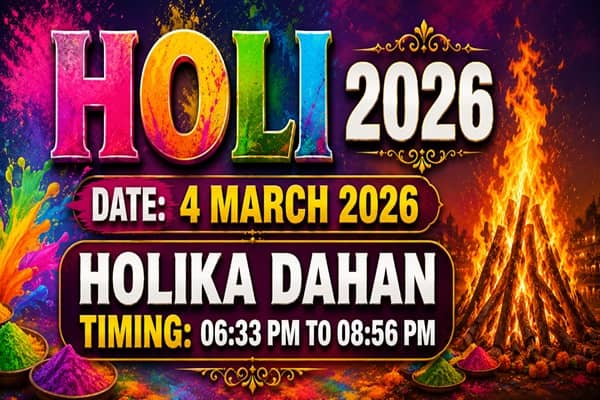
The night before, on Tuesday, 3 March 2026, is Holika Dahan. This is the ritual bonfire. The dates are not guesses. They come from the panchang, the traditional Hindu calendar that tracks the movement of the moon and the sun.
People often ask holi kab hai 2026 or when is holi in 2026. Now you have the answer. Mark your calendar. 3 March for the fire. 4 March for the colors.
Holika Dahan 2026 Shubh Muhurat
The Holika Dahan ritual is not a casual bonfire. It must be performed at the right time. The auspicious window is during Pradosh Kaal, the period just after sunset, when the Purnima Tithi is active and the inauspicious Bhadra period has ended.
In 2026, the Holika Dahan muhurat runs from 6:22 PM to 8:50 PM on 3 March. The duration is 2 hours and 28 minutes. This is the window when the fire should be lit.
Do not light the bonfire before 6:22 PM. Do not light it after 8:50 PM. The power of the ritual comes from the alignment of time. Light the fire within the muhurat. Chant the prayers. Offer the grains. Walk the parikrama. This is how you invite blessings.
The Purnima Tithi begins at 5:55 PM on 2 March and ends at 5:07 PM on 3 March. Yes, the Tithi overlaps across two calendar dates. But the ritual is performed on the evening of 3 March because that is when the full moon rises after sunset.
The Story of Prahlad and Holika
You cannot understand Holi without understanding the story. It is the reason for the fire.
Hiranyakashipu was a demon king. He had received a boon from Lord Brahma. He could not be killed by man or animal. Not indoors or outdoors. Not during day or night. Not on ground or in sky. No weapon could harm him. He felt invincible. He demanded that everyone worship him as god.
His son, Prahlad, refused. Prahlad was a devotee of Lord Vishnu. He sang Vishnu’s name. He spoke Vishnu’s name. He breathed Vishnu’s name. Hiranyakashipu tried everything to make Prahlad stop. Poison. Snakes. Elephants. Nothing worked. Vishnu protected the boy every time.
Finally, Hiranyakashipu turned to his sister, Holika. Holika had a shawl that made her immune to fire. She agreed to sit in a burning pyre with Prahlad on her lap. The fire would not hurt her. But the boy would burn.
The pyre was lit. The flames rose high. Holika sat in the center, holding Prahlad. But the shawl flew off her shoulders and wrapped around Prahlad. Holika burned to ash. Prahlad emerged unharmed, still chanting Vishnu’s name.
That is Holika Dahan. The burning of evil. The protection of faith. The lesson that arrogance, no matter how powerful, will always be defeated by devotion.
Holika Dahan 2026 Puja Rituals
At the appointed muhurat, the family gathers around the bonfire. The fire has been prepared in advance. Wood logs, dry leaves, cow dung cakes, and straw are stacked into a pyre. In some regions, an effigy of Holika is placed on top.
The puja is simple. You take water, roli, rice, flowers, coconut, and grains from the new harvest. You circle the fire three, five, or seven times. As you walk, you chant prayers. The most common mantra is Om Namah Shivaya, but you can also chant Vishnu mantras or simply pray in your own words.
You offer the items into the fire. The coconut symbolizes ego. Breaking it into the flames shatters pride. The grains symbolize gratitude for the harvest. The water and flowers are offerings of purity.
After the offerings, you touch the feet of the elders. You take the blessings of the fire. You return home with lighter heart.
Some traditions also include a remedy using the ashes. The next morning, when the fire is cold, you take a small amount of ash. You mix it with water. You apply it to your forehead. This ash is believed to protect from the evil eye and negative energy.
Rangwali Holi 2026: The Day of Colors
4 March 2026 is the day everyone waits for. Wake up early. Apply oil to your hair and skin. The oil makes it easier to wash off the colors later. Wear old clothes. White is traditional, but anything cheap and washable works.
The celebration begins with a puja. In some regions, people worship Krishna or Vishnu. In others, they simply offer prayers to the fire that burned the night before. Then the colors come out.
Gulal, the dry powder, is thrown into the air. It clouds the sun and turns the sky pink. Abir, a brighter variant, stains cheeks and foreheads bright red. Water from pichkaris, long syringe like toys, soaks through clothes. Buckets of colored water are poured on unsuspecting friends. No one is safe. That is the point.
By afternoon, everyone looks like a rainbow. Strangers become friends. Old grudges are forgotten. The neighbor you fought with last month comes over and smears green powder on your face. You cannot stay angry. The color does not let you.
Evening brings a different energy. The colors are washed off. New clothes are worn. Families gather for sweets and feasting. The tension of the year is gone. The joy remains.
Mathura and Vrindavan: The Holi That Lasts Weeks
If you want to see Holi at its most intense, go to Braj. The land of Krishna. The celebrations here do not last one day. They last weeks.
The schedule is specific. 24 February 2026 is Laddu Holi at Barsana’s Sriji Temple. 25 February is Lathmar Holi in Barsana, where women playfully hit men with sticks. 26 February is Lathmar Holi in Nandgaon. 27 February is Holi at Banke Bihari Temple in Vrindavan, a chaotic, ecstatic event where the temple fills with chanting and colors. 28 February is Phoolon Ki Holi, the flower Holi, where petals are thrown instead of powder.
Then, on 3 March, Holika Dahan is observed across the region. On 4 March, Dhulandi Holi, the main color festival, sweeps through every street.
The energy in Braj is different. The devotion is raw. The singing is loud. The colors are thick. If you can only celebrate Holi once in your life, celebrate it here.
Holi Recipes That Make the Festival Sweeter
Holi is not just about colors. It is about food. The kitchen is as busy as the streets.
Gujiya is the queen of Holi sweets. A dumpling made of semolina and flour, stuffed with khoya, dried fruits, and nuts. Deep fried until golden. Soaked in sugar syrup. Bite into one and the sweetness spills out.
Malpua is another favorite. A pancake made of flour, milk, and mashed bananas. Fried in ghee until crispy. Served hot, sometimes with rabri, thickened milk.
Thandai is the drink of Holi. A cold milk beverage flavored with cardamom, saffron, fennel seeds, rose petals, and nuts. Some versions include bhang, a cannabis paste, but that is traditional only in specific regions. The non intoxicating version is just as delicious.
Make these at home. Share with neighbors. The food carries the same message as the colors. Take. Eat. Be happy.
Also Read : Bageshwar Dham Chhatarpur Temple: Timings, Divya Darbar Token & Online Registration
Eco Friendly Holi: A Necessary Reminder
The colors of Holi are beautiful, but the chemicals in cheap powders are not. They burn the skin. They dry the hair. They pollute the water. They stain clothes permanently.
Traditional Holi used natural colors. Red from hibiscus flowers. Yellow from turmeric. Green from neem leaves. Blue from indigo. These colors are safe. They wash off easily. They do not harm the environment.
This Holi, choose natural colors. Make them at home. Or buy from trusted sources. Avoid the bright, cheap powders that smell like chemicals. Your skin will thank you. The earth will thank you.
Also save water. Dry Holi, with only powder, is just as fun as wet Holi. The water in many regions is scarce. Do not waste it throwing buckets at friends. A smear of gulal carries the same blessing.
Forgive and Forget: The Spiritual Core of Holi
Holi asks one thing of you. Forgive. The person who hurt you last year. The friend you stopped speaking to. The neighbor you avoid in the elevator.
Walk to them. Smile. Smear a little color on their face. They will smear color on yours. Two minutes of awkwardness. A lifetime of relief.
Holding grudges is like carrying a stone in your pocket. It weighs you down. It serves no purpose. Holi is the day you take that stone out and throw it into the fire. Let it burn. Watch the smoke rise. Breathe easier.