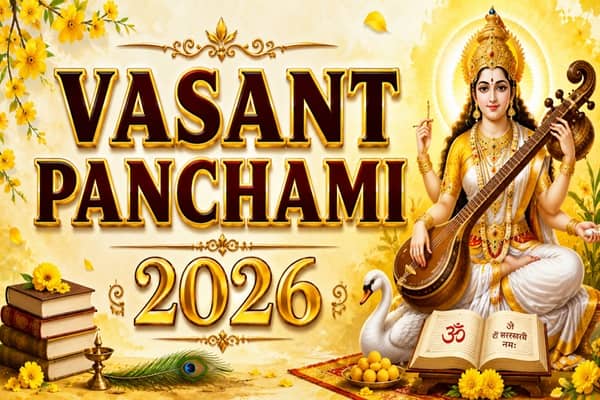
The mustard fields of Punjab turn bright yellow. The air in Bengal smells of incense and fresh flowers. In Tamil Nadu, a child holds a pencil for the first time, guided by a parent’s hand. This is Vasant Panchami. Not a loud festival with crackers and processions. A quiet one. A festival of yellow, of books, of music, of the first warm breeze after winter’s chill. It arrives on the fifth day of the bright half of the month of Magha, when the Panchami Tithi blesses the calendar. In 2026, that day falls on Friday, 23 January.
The name tells you what it celebrates. Vasant means spring. Panchami means the fifth day. Together, they mark the transition from the cold stillness of winter to the vibrant energy of new growth. Trees that looked bare for months now show tiny green buds. The sun feels warmer on your skin. And somewhere inside you, something stirs. An urge to learn. To create. To begin something new.
Vasant Panchami 2026 Date and Muhurat
The Panchami Tithi begins at 02:28 AM on 23 January 2026. It ends at 01:46 AM on 24 January 2026. Because Hindu festivals are observed based on sunrise timings, Vasant Panchami falls on 23 January.
The most auspicious window for Saraswati Puja is the morning hours. The general Muhurat runs from 07:15 AM to 12:50 PM. This five hour and thirty six minute period is considered ideal for invoking the goddess. The Madhyahna moment, the exact midday point, occurs at 12:50 PM.
Do not worry if you cannot perform the puja exactly within these hours. The entire morning carries the energy of the festival. The key is to perform your rituals before noon. Late afternoon and evening are less favorable.
If you live outside India, the date remains the same. Adjust your puja time to the morning hours in your local time zone. The goddess does not check your clock. She checks your heart.
Why Yellow Is Everywhere
Walk into any Vasant Panchami celebration, and yellow surrounds you. Yellow clothes. Yellow flowers. Yellow sweets. Yellow decorations. This is not a random choice. Yellow is the color of knowledge, optimism, and spiritual illumination. It is the color of turmeric, which purifies. It is the color of the mustard flower, which carpets the fields of North India at this time of year.
Mustard blooms exactly when Vasant Panchami arrives. The farmers see the yellow fields and know that spring has come. The devotees wear yellow and know that Goddess Saraswati is near. She is the deity of wisdom, learning, music, arts, and creative expression. Her favorite color is yellow. Offering her yellow things is like offering her your own desire for clarity and growth.
The famous saying in North India captures the spirit. Til gud ghya, god god bola, which means take this sesame and jaggery and speak sweetly. On Vasant Panchami, the sweetness is not just in the mouth. It is in the intention. You dress in yellow. You eat yellow sweets. You speak words that are warm and kind. The color trains your mind to be optimistic, even when life feels cold.
Goddess Saraswati and the Gift of Knowledge
According to Hindu mythology, there was a time when the world was chaotic. Ignorance ruled. Disorder reigned. Goddess Saraswati manifested on Vasant Panchami to bring structure, language, sound, music, wisdom, and refined intellect. She did not come with a sword. She came with a veena, a musical instrument. She came with a book. She came with a rosary. Her message was simple. Knowledge is the weapon that defeats all demons.
The Rig Veda contains hymns dedicated to Saraswati as a river. Over time, she became the goddess of the flowing waters of consciousness. The river Saraswati is said to flow underground, invisible to the eye but still present. Similarly, wisdom flows beneath the surface of your mind. You cannot see it, but it is there. Vasant Panchami is the day you dip into that river.
Students worship her for academic success. Artists worship her for creative inspiration. Musicians worship her for mastery over their instruments. Writers worship her for words that flow like water. Anyone who uses their mind, which means everyone, can pray to her.
The Story of Kama Deva and the Awakening of Spring
Another legend explains the festival differently. After his wife Sati died, Lord Shiva retreated into deep meditation. He withdrew from the world. He lost interest in creation. The universe needed him to return, to marry Parvati, to become a householder again.
The gods sent Kama Deva, the lord of love, to shoot his flower arrow at Shiva. Kama Deva succeeded. Shiva felt desire again. But when he opened his third eye and saw who had disturbed his meditation, he burned Kama Deva to ashes.
Rati, Kama Deva’s wife, pleaded with Shiva. Shiva agreed to bring Kama Deva back, but not in physical form. From that day, love became a feeling, not a body. And the day this happened was Vasant Panchami. So the festival also represents the return of passion, desire, and engagement with the world after a period of withdrawal.
This is why Vasant Panchami is considered the day when the gods themselves celebrate spring. The earth shakes off its winter slumber. Life returns to the fields. And you, like Shiva, are invited to re engage with the world, not with detachment, but with love.
How to Perform Saraswati Puja at Home
You do not need a priest or a temple to celebrate Vasant Panchami. A simple puja at home, done with focus and devotion, is enough.
Start by cleaning the space where you will perform the puja. Take a bath. Wear clean yellow clothes. Place an idol or picture of Goddess Saraswati on a clean platform. If you have a veena, a musical instrument, place it near the deity. If not, any symbol of learning will do.
The offerings are simple. Yellow flowers, marigolds are perfect. Yellow sweets, like kesar halwa or any saffron tinged dessert. Fruits. Incense. A lit diya, a lamp filled with ghee or oil.
The most important part of the puja is the offering of your tools of learning. Students should place their books, notebooks, pens, and pencils at the feet of the goddess. Artists should place their brushes, canvases, or any creative material. Musicians should place their instruments. Writers should place their notebooks or laptops.
Then chant the Saraswati mantra. The simplest one is Om Aim Saraswatyai Namah. The seed syllable Aim represents pure knowledge and consciousness. Chant it eleven times or one hundred and eight times if you have the time. You can also chant the Saraswati Gayatri Mantra. Om Aim Vagdevyai Cha Vidmahe, Kameshwaryai Cha Dhimahi, Tanno Devi Prachodayat.
After the chanting, perform the aarti. Wave the lit lamp in front of the deity. Ring a small bell if you have one. Pray for clarity, focus, and the ability to learn and create.
Distribute the prasad to family members. Do not let the food sit. Share it fresh. Sharing is part of the ritual.
Akshar Abhyasam: The First Writing Ceremony
One of the most beautiful traditions of Vasant Panchami is Akshar Abhyasam, also known as Vidyarambham. This is the ceremony where a young child writes their first letters. The child sits on the lap of a parent or grandparent. A tray of rice is placed before them. The parent guides the child’s hand to write Om or the first letters of the alphabet in the rice.
This tradition is based on the belief that learning should begin on an auspicious day blessed by the goddess of knowledge. The child is not just learning to write. They are being initiated into a lifetime of learning. The first stroke of the pencil or the first finger drawn in the rice is a prayer. May this child’s mind be sharp. May their curiosity never fade. May they find joy in books, in questions, in the endless adventure of knowing.
If you have a young child, perform this ceremony on Vasant Panchami. Even if the child has already started school, you can still do it. Write a new alphabet. Start a new subject. The goddess does not mind being late.
For adults, the same principle applies. Start a new course on Vasant Panchami. Begin writing that book you have been planning. Learn a new musical instrument. The day carries the energy of new beginnings. Use it.
Saraswati Mantras for Wisdom and Clarity
Chanting mantras on Vasant Panchami is believed to greatly enhance intellect, memory, and creative expression. The sound vibrations penetrate the mind and clear the fog of confusion.
The Saraswati Beej Mantra is Om Aim Saraswatyai Namah. Chant this daily, not just on the festival day. The syllable Aim is the seed of the goddess. It activates the throat chakra, which governs communication and self expression.
The Saraswati Gayatri Mantra is Om Aim Vagdevyai Cha Vidmahe, Kameshwaryai Cha Dhimahi, Tanno Devi Prachodayat. This mantra asks the goddess to illuminate our intellect and guide our speech.
The traditional Saraswati Vandana describes the goddess as radiant, pure, and seated on a white lotus. Ya Kundendu Tushara Hara Dhavala, Ya Shubhra Vastravrita. Ya Veena Varadanda Manditakara, Ya Shveta Padmasana. She is white like the jasmine, the moon, and the snow. She is dressed in white. She holds a veena. She sits on a white lotus. Chanting this description brings her presence into your mind.
For beginners, a simple prayer in your own language works perfectly. Goddess Saraswati, please remove the darkness of ignorance from my mind. Grant me wisdom. Let my words be sweet and my learning steady.
Also Read : Makar Sankranti 2026: Date, Punya Kaal Timings, Rituals & Significance
Celebrations Across India
Vasant Panchami wears different clothes in different states. In West Bengal, Odisha, and Assam, it is Saraswati Puja, a major festival. Schools and colleges close for the day. Students decorate the campus. Large idols of the goddess are installed in pandals. The puja is often organized by the students themselves. They collect donations. They prepare the offerings. They perform the rituals. It is a lesson in responsibility as much as devotion.
In Punjab and Haryana, the mustard fields are in full bloom. People wear yellow turbans and yellow dupattas. Kite flying is a popular tradition. The sky fills with colorful kites. The cut kite drifts away, and someone else’s kite takes its place. The sound of the strings, the shouts of children, the warmth of the sun, this is how spring is welcomed.
In Uttar Pradesh and Bihar, the festival is called Basant Panchami. Sweets made of sesame and jaggery are distributed. The phrase Til gud ghya, god god bola is heard everywhere. Eat this sweet, speak sweetly.
In Tamil Nadu and Karnataka, Vasant Panchami is observed as the day for Vidyarambham. Temples conduct the first writing ceremony for young children. Even though the main Saraswati Puja in the south happens during Navaratri, this day is still marked for new beginnings in education.
In Nepal, the festival is celebrated with great enthusiasm. Students clean their books and place them at the feet of the goddess. Special ceremonies are held at the Swayambhunath Stupa, where the statue of the goddess is dressed in yellow.
The Role of Rudraksha in Learning
In traditional spiritual practice, seekers have used sacred tools to stabilize the mind and sharpen awareness. One such tool is the Rudraksha, a seed that has been worn for centuries by sages, students, and spiritual aspirants. The 12 Mukhi Rudraksha is associated with the Sun, which represents the soul, authority, and clarity. Wearing it is believed to support concentration, emotional balance, and self confidence.
On Vasant Panchami, some devotees wear Rudraksha beads while chanting Saraswati mantras. The combination is believed to deepen the effect of the prayers. The bead serves as a physical reminder of your intention. Every time you touch it, you remember the goddess and your commitment to learning.
If you are a student struggling with focus, or an artist facing creative blocks, consider wearing a Rudraksha. It is not a magical solution. It is a tool. It helps you help yourself.
What to Eat and What to Offer
The festival has a seasonal menu. Mustard greens, saag, cooked with spices and served with makki di roti, a flatbread made of cornmeal, is a winter staple in North India. The combination is hearty and warming.
Sweets made of sesame, til, and jaggery, gud, are distributed. Sesame generates heat in the body, which is useful in winter. Jaggery is unrefined sugar, considered healthier than white sugar. Together, they represent the balance of health and pleasure.
Kesar halwa, a semolina pudding colored with saffron, is another popular offering. The saffron turns the halwa yellow. The sweetness pleases the goddess. The warmth comforts the devotee.
Offer these foods to the goddess during the puja. Then eat them as prasad. The food carries the blessing.
What Not to Do on Vasant Panchami
Do not eat meat or drink alcohol on this day. The festival is sattvic, pure, and meant to elevate the mind. Heavy foods dull the intellect.
Do not let anger or harsh words escape your mouth. The day is for sweetness. If you cannot speak sweetly, say nothing.
Do not waste the day in entertainment that numbs the mind. Avoid excessive screen time. Avoid gossip. Focus on learning, creating, or praying.
Do not neglect your books and tools of learning. If you are not a student, reflect on what you are learning in your life right now. Every adult is still a student. Life is the teacher.
Do not hoard knowledge. Share what you know. Teach someone something on this day. That is the highest offering to the goddess.
The Deeper Message of Vasant Panchami
The world tells you that learning ends with a degree. Vasant Panchami tells you otherwise. Learning is the thread that runs through your entire life. Every year, spring returns. Every year, new flowers bloom. Every year, you have the chance to learn something new, to create something beautiful, to express yourself with clarity and compassion.
The goddess sits on a white lotus. The lotus grows in mud but remains unstained. Your mind, too, lives in a messy world. But it can remain clear. It can remain focused. It can rise above the mud of confusion and produce the flower of wisdom.
Vasant Panchami 2026 is not just a date on the calendar. It is an opportunity. Take a book that has been gathering dust on your shelf and read one chapter. Write the first page of that story you have been thinking about. Learn the first three chords on a guitar. Teach your child how to write the letter A. The goddess does not ask for grand gestures. She asks for a sincere heart and a curious mind.
The mustard fields will bloom. The kites will fly. The yellow sweets will be shared. And somewhere, in a quiet corner, someone will pick up a pencil and begin. That is the true celebration. That is Vasant Panchami.