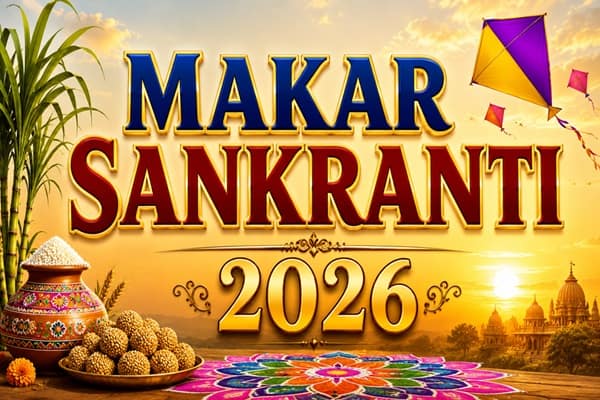
The Sun begins its northward journey. Days grow longer. The winter chill slowly loosens its grip. And across India, from the farms of Punjab to the coast of Tamil Nadu, people step outside to greet the warmth. This is Makar Sankranti, a festival that does not announce itself with grand processions or midnight countdowns. It arrives quietly, like the sunlight itself, and settles into everyday life. You notice it in the kitchen, where sesame and jaggery are rolled into sweets. On the terrace, where old kites are pulled out of storage. In the temple, where water is offered to Surya Dev with folded hands.
Unlike most Hindu festivals that follow the lunar calendar, Makar Sankranti follows the Sun. That is why the date stays almost the same every year. In 2026, Makar Sankranti falls on Wednesday, 14 January. The Sun enters Capricorn, the sign called Makara in Sanskrit. This transition, known as Uttarayan, is considered the day of the devas, the gods. The six months from now until July are seen as a favorable period for spiritual growth, new beginnings, and letting go of old burdens.
Punya Kaal and Mahapunya Kaal Timings for 2026
The exact moment of the Sun’s transition is called the Sankranti moment. In 2026, this happens at 7:52 AM on 14 January. The period from this moment until sunset is called Punya Kaal, the auspicious time when any spiritual action brings multiplied benefit.
The most powerful window is the Mahapunya Kaal, which runs from 7:52 AM to 9:18 AM. During these ninety minutes, the celestial alignment is considered most potent. Holy baths, charity, mantra chanting, and prayers performed in this window are believed to yield the highest results.
Punya Kaal continues from 7:52 AM to 5:46 PM. If you miss the early morning window, do not worry. The entire day carries the energy of the transition. Any act of devotion, generosity, or self reflection performed on this day is meaningful.
Do not get caught in the trap of thinking that spirituality runs on a clock. The auspicious timings are not magic. They are reminders. They help you pause, focus, and direct your intention. A holy bath taken at 8:00 AM with sincere prayer is powerful. A donation made at 4:00 PM with a clean heart is equally valuable. The time is a frame. The devotion inside the frame is what matters.
The Sacred Bath: More Than Just Water
Millions of people will wake up early on 14 January and head to rivers, lakes, or even their own bathrooms for a ritual bath. At the Ganga in Haridwar, at the Godavari in Nashik, at the Yamuna in Delhi, devotees will immerse themselves in cold water. They will shiver, smile, and come out feeling lighter.
The bath is not just about washing the body. It is a symbolic act of cleansing. You stand in the water and imagine all the mistakes, regrets, and negativity of the past year washing away. The cold shocks you awake. The water purifies. You step out feeling reborn.
But the bath alone does nothing if your heart remains unchanged. Water can clean your skin. Only your own effort can clean your conscience. As you bathe, reflect on one thing you want to let go of. A habit. A grudge. A fear. Resolve to leave it behind. That is the real snan.
If you cannot reach a river, bathe at home. Add a few drops of Ganga water if you have it. Light a lamp. Say a simple prayer. The goddess is not in the river alone. She is in your intention.
Offering Water to the Sun
After the bath, fill a copper vessel with water. Face the rising sun. Slowly pour the water back to the earth while chanting a mantra. The simplest one is Om Suryaya Namah. Repeat it eleven times if you can.
This act is called Arghya. It is a greeting. You are welcoming the sun after his long southern journey. You are thanking him for returning with warmth and light. You are asking for his blessings for the six months ahead.
The copper vessel matters. Copper conducts energy. It balances the body’s subtle currents. If you do not have copper, any metal or even a clay pot works. The material is secondary. The act of offering, with folded hands and a grateful heart, is primary.
Children can do this too. Teach them to face the sun, close their eyes, and say thank you. They will not understand the astronomy. They will understand gratitude. That is enough.
Charity That Opens the Heart
Makar Sankranti is considered one of the most powerful days for charity. The tradition is to give sesame seeds, jaggery, blankets, warm clothes, food grains, and money to those in need. Sesame and jaggery are not random choices. Sesame represents endurance, the ability to survive harsh conditions. Jaggery represents sweetness, the choice to be kind even when life is bitter.
The act of giving is not about the object. It is about loosening your grip on what you own. You hold a blanket that you could use. You give it to someone who needs it more. Something in your heart softens. That softening is the real charity.
Do not give only to the poor. Give to anyone who crosses your path with genuine need. The vegetable vendor who looks tired. The security guard standing in the cold. The domestic worker who has no warm clothes. A small gesture, a packet of til gud, a cup of tea, a few rupees, changes their day and changes you.
If you cannot give materially, give your time. Sit with an elderly relative. Call a friend you have not spoken to in months. Forgive someone who hurt you. These are charities of the heart. On Makar Sankranti, they count as much as any donation.
The Sweet Message of Til Gud
In Maharashtra, families exchange til gud laddoos and say, Til gud ghya, god god bola. Take this sweet, and speak sweetly. The tradition is simple and profound. You put something sweet in your mouth. You make a promise to keep your words sweet for the rest of the year.
Harsh words break relationships. Kind words build them. On Makar Sankranti, you are reminded that what comes out of your mouth matters as much as what goes in. The sesame and jaggery are a prayer. May my speech be as warm as this sweet. May my words heal, not harm.
If you have a strained relationship with someone, this is the day to reach out. Send a message. Make a call. Offer a til gud laddoo. The sweetness on your tongue will soften your heart. The words will come easier than you expect.
Kites That Reach for the Sky
In Gujarat and Rajasthan, the sky turns into a canvas of color on Makar Sankranti. Kites of every shape and size fill the air. Children run on terraces. Adults shout encouragement. The cut kite drifts away, and someone else’s kite takes its place.
The kite is a metaphor. You hold the string. The wind lifts the kite. You release and pull, release and pull. The kite rises higher. Your worries seem smaller from up there.
Letting a kite go is not losing. It is releasing. Something you were holding too tight. A fear. A disappointment. An old story you keep telling yourself. Let it go. Watch it drift until you cannot see it anymore. The sky is vast. It can hold your pain and still have room for joy.
If you do not have kites, make your own from newspaper. The effort, not the expense, carries the meaning.
Pongal and Lohri and Bihu: One Festival, Many Names
Makar Sankranti wears different clothes in different parts of India. In Tamil Nadu, it becomes Pongal. Rice is boiled in a new pot until it overflows. Pongal means overflowing abundance. Families thank the Sun, the rain, and the cattle for the harvest.
In Punjab, the night before is Lohri. Bonfires are lit. People dance the bhangra around the flames. They throw peanuts, popcorn, and sesame seeds into the fire, an offering to Agni, the god of fire, for warmth and prosperity.
In Assam, it is Magh Bihu. Community feasts are held. Temporary huts made of bamboo and leaves are built, and then burned the next morning, symbolizing the end of the harvest season and the beginning of a new cycle.
In Uttar Pradesh and Bihar, devotees throng to Prayagraj for a holy dip at the Sangam, the confluence of the Ganga, Yamuna, and the mythical Saraswati. The crowd is immense. The faith is palpable. People stand in cold water up to their waists, chanting, singing, and praying.
The names and rituals change. The essence does not. Gratitude. Generosity. Renewal. Every region, every family, finds its own way to say thank you.
Also Read : Maa Kamakhya Temple Timings 2026: Darshan, VIP Pass, Puja & Festivals
What the Bhagavad Gita Says About Uttarayan
Lord Krishna says in the Bhagavad Gita that those who die during Uttarayan, when the sun is in the northern path, attain higher realms. The verse is often quoted to emphasize the sacredness of this six month period.
But do not misunderstand. The Gita is not offering a shortcut. It is describing a state of consciousness. When your mind is turned toward light, when your actions are guided by goodness, when your heart is fixed on the divine, then your departure, whenever it happens, is auspicious.
You do not need to wait for death to benefit from Uttarayan. Live as if every day is the northern path. Wake up with gratitude. Act with integrity. Speak with kindness. Rest with peace. That is the true meaning of the Gita’s teaching.
What to Do and What to Avoid
Do wake up early. Do take a bath, even if you cannot reach a river. Do offer water to the sun. Do eat til gud. Do share food with neighbors, colleagues, and those in need. Do donate something, no matter how small. Do fly a kite or watch one fly. Do call your parents and tell them you love them. Do forgive someone who has wronged you.
Do not eat meat or drink alcohol on this day. Do not let anger or harsh words escape your mouth. Do not sleep through the morning. Do not waste the day in idle entertainment. Do not hold grudges. Do not hoard what you can share.
These are not punishments. They are practices. Each one is designed to lift your energy, cleanse your mind, and align you with the festival’s purpose.
The Deeper Message of Makar Sankranti 2026
The Sun moves from Sagittarius to Capricorn. Capricorn is the sign of discipline, structure, patience, and long term effort. This is not the time for quick fixes or instant results. This is the time for steady work. For showing up every day, even when you do not feel like it. For trusting that small actions, repeated over time, will yield big changes.
Makar Sankranti 2026 asks you a question. What direction are you facing? Not with your body. With your heart. Are you moving toward light or away from it? Toward growth or stagnation? Toward love or fear?
The festival does not give you answers. It gives you a moment to ask the questions. Stand in the cold morning air. Watch the sun rise. Feel the warmth on your face. And decide. From this day until the sun begins its southern journey again, how will you live?
The sky does not rush. The sun does not hurry. The seasons change at their own pace. But they do change. And so can you.